Testing testing 123

We’re testing out the iPhone to WordPress blog posting ability. If this works, maybe we’ll be able to post updates more often. Beep boop.
Stay tuned.
UPDATED: Sugarhouse Park Dumped Animals
UPDATE: DISREGARD MY PLEAS. WE WERE ABLE TO RESCUE THE DUCKS TODAY, DECEMBER 30TH. SPECIAL THANKS TO TAD, JARED, CEEJAY, SHANNON AND JESSICA.

You can easily see the 15 domestic ducks because none of them could fly over a 3′ fence. They just walked into the box and were picked up. That’s how you can tell they don’t belong in the wild.
All of them are headed to safe forever pet homes now.
View the summary video.
ORIGINAL POST
This blog post is for Salt Lake County Parks & Recreation, Salt Lake County Council, The Sugar House Park Authority Board of Trustees and USDA-APHIS Wildlife Services in Utah.
We need to get these domestic ducks off of Sugarhouse Park pond as soon as possible. We’re working on homes for them all right now. It is not acceptable for domestic pet ducks to be left out in the open on a drained, frozen pond.

I personally watched this domestic pet duck get ripped apart while still alive. She screamed for several minutes. Eagles need to eat, but this is unnecessarily cruel and not a natural food source for them.

When the pond is drained, as it is now for winter, the dumped domestic ducks are left with nowhere to hide. They have about a 15′ round area of open water at the West end of the pond and that’s all. The center area has frozen over since Monday.
A few facts about domestic ducks versus wild ducks.

Domestic ducks are 2-3x larger than wild ducks. They’re bred larger for meat and eggs. For farm use. People also buy them for pets. They’re purchased in the spring from farm feed stores or KSL classifieds and many are dumped in the fall. Many people don’t know it’s illegal to dump pet ducks in public parks and ponds (Utah Code: Title 76 Chapter 9 Part 3 Section 301).
In the past, someone (maybe the Parks Department knows who?) has deliberately placed large numbers of urban mallards and domestic pet ducks on Sugarhouse Park pond. I do not know if that is how these specific ducks appeared at the park. But I know they need urgent help.
As of Wednesday, December 30th we have found safe forever pet homes for 13 of the 15 known dumped domestic ducks shown here. We’re still working on homes for a few boys. (People dump boys more than girls because they can be too aggressive to females and they don’t lay eggs.)

I’ve labeled the domestic dumped ducks, as well as an American Coot that does not belong there, in this photo.
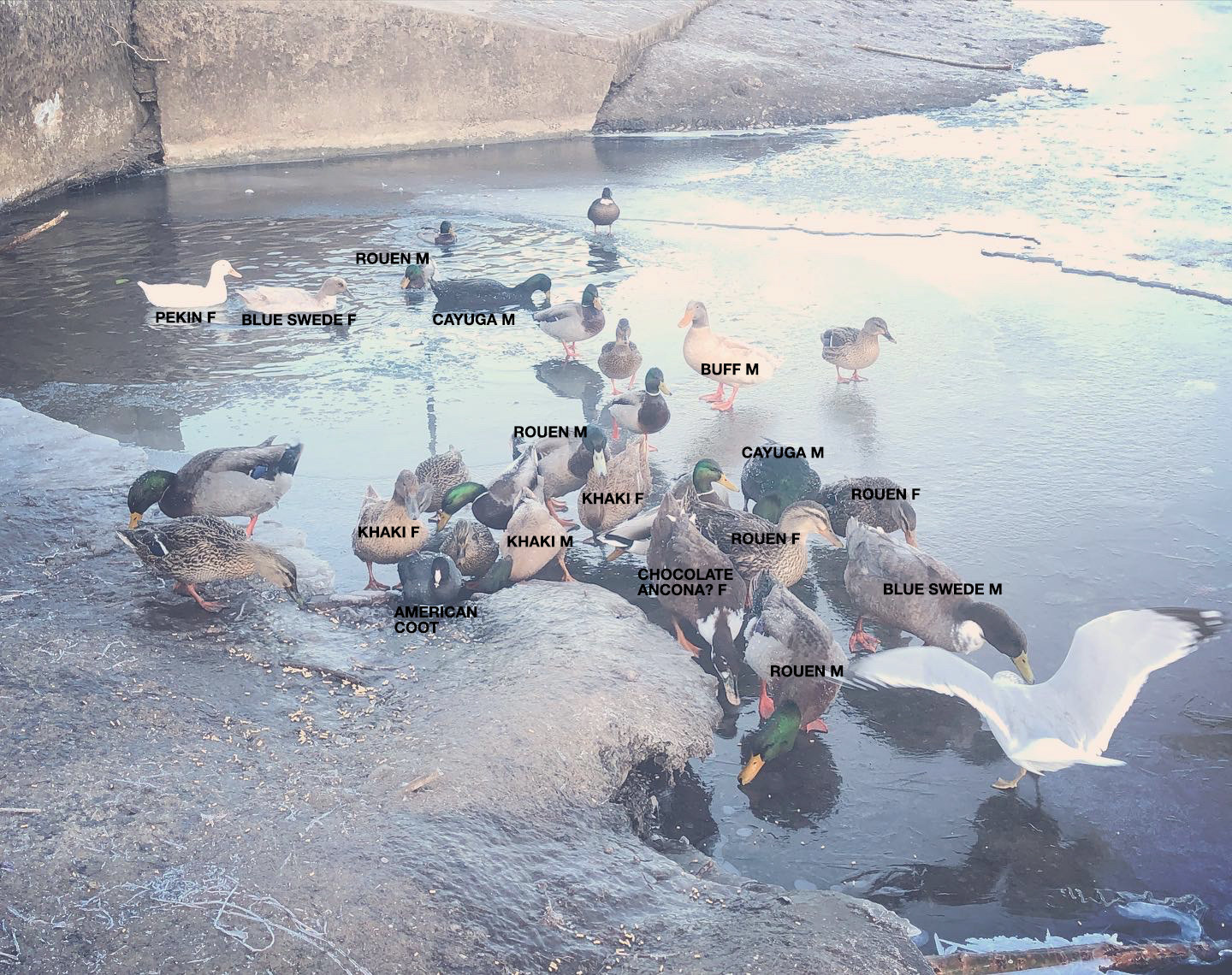 You can click the image to view it larger.
We (myself and two other local backyard rescuers) can save these ducks now. We can also transport the American Coot to WRCNU for evaluation and re-release at an appropriate site.
But we need this to stop happening.

This happens every single year. We’ve rescued dumped domestic ducks off of Sugarhouse Park pond year after year after year and we can’t do it anymore. There’s nowhere for them to go. If the Parks department knows who is placing ducks on the pond, they need to make them stop. I’ve personally spent thousands of dollars on veterinary bills on dumped ducks from Sugarhouse Park pond.

When they’re left with only a tiny open pool at the end of a frozen, drained pond they die. Even when they’re not being eaten alive by eagles they end up with foot injuries, with broken legs, with starvation, chased by off-leash dogs and more.
Please help me stop it.
I’ve reached out to Jared Z. with USDA-Aphis/Wildlife Services to enlist his help with rounding up the ducks. We’ve worked together before when he has done roundups and we’ve had room to take some domestics. If the rest of you need to coordinate to allow this to happen, please do. Quickly. We can be ready by Monday, January 4th to take these ducks.
Please respond. I realize you have many competing priorities. But time is of the essence here.
Happy Holidays 2020
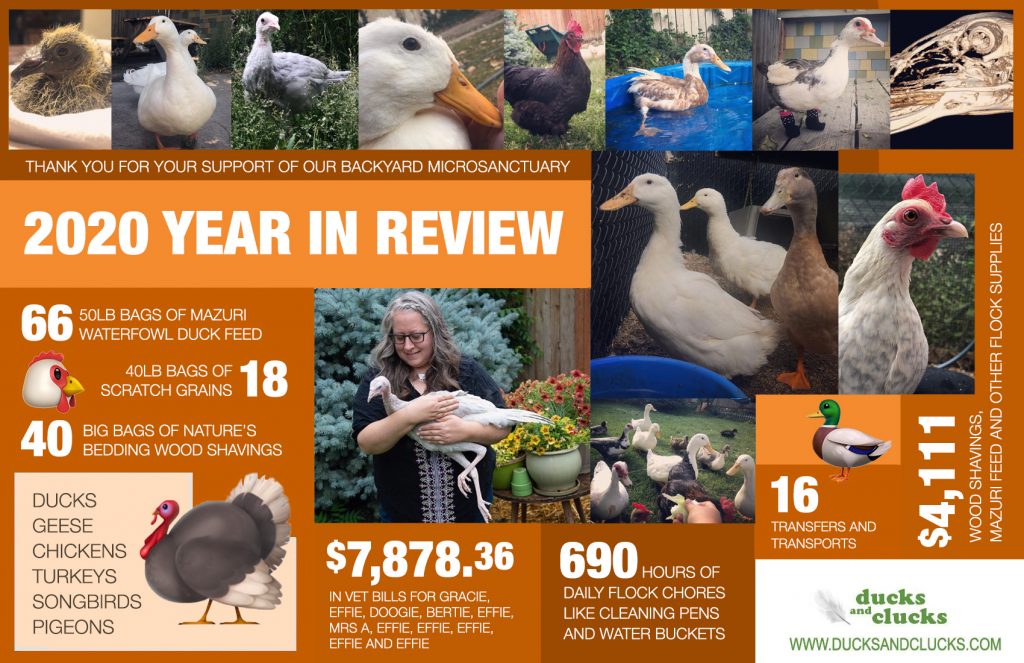
Happy 2020 Holidays and/or Merry Christmas
It’s been 15+ years since I’ve successfully written, printed and mailed Christmas cards, so I’m finally giving up hope that I’ll ever get that done and moving to a digital-only holiday card. This year has been interesting, eh?
Some of you may know I worked as a creative director/consultant, traveling by airplane to run various corporate strategy workshops all over the US, and then working from home to deliver projects between trips. My last trip was March 4th-6th in Maryland, just as news of a global pandemic was emerging. I wasn’t too concerned though, as I had video script, storyboard and production work I could complete at home, booked through August. Then that work was moved away from me to an on-staff employee, since I’m just a contractor. D’oh!

So I was thrust into the uncertainty and chaos of pandemic unemployment along with everyone else. Utah also had an extra special start to the pandemic with a 5.7M earthquake. That’s the largest quake in my lifetime. Luckily my 1911 house survived with just a few new cracks.

Since March, I’ve been helping to keep some older family members safely out of grocery stores and restaurants and such, while trying hard to keep myself safe too. I take the CDC recommendations very seriously and have thankfully been healthy so far. I’m still volunteering for my sanctuary family during the pandemic, too. They’re still living in a church while awaiting asylum, since January 2018! I help coordinate the volunteer schedule to have on-call help 24/7/365 and ensure their safety and comfort.
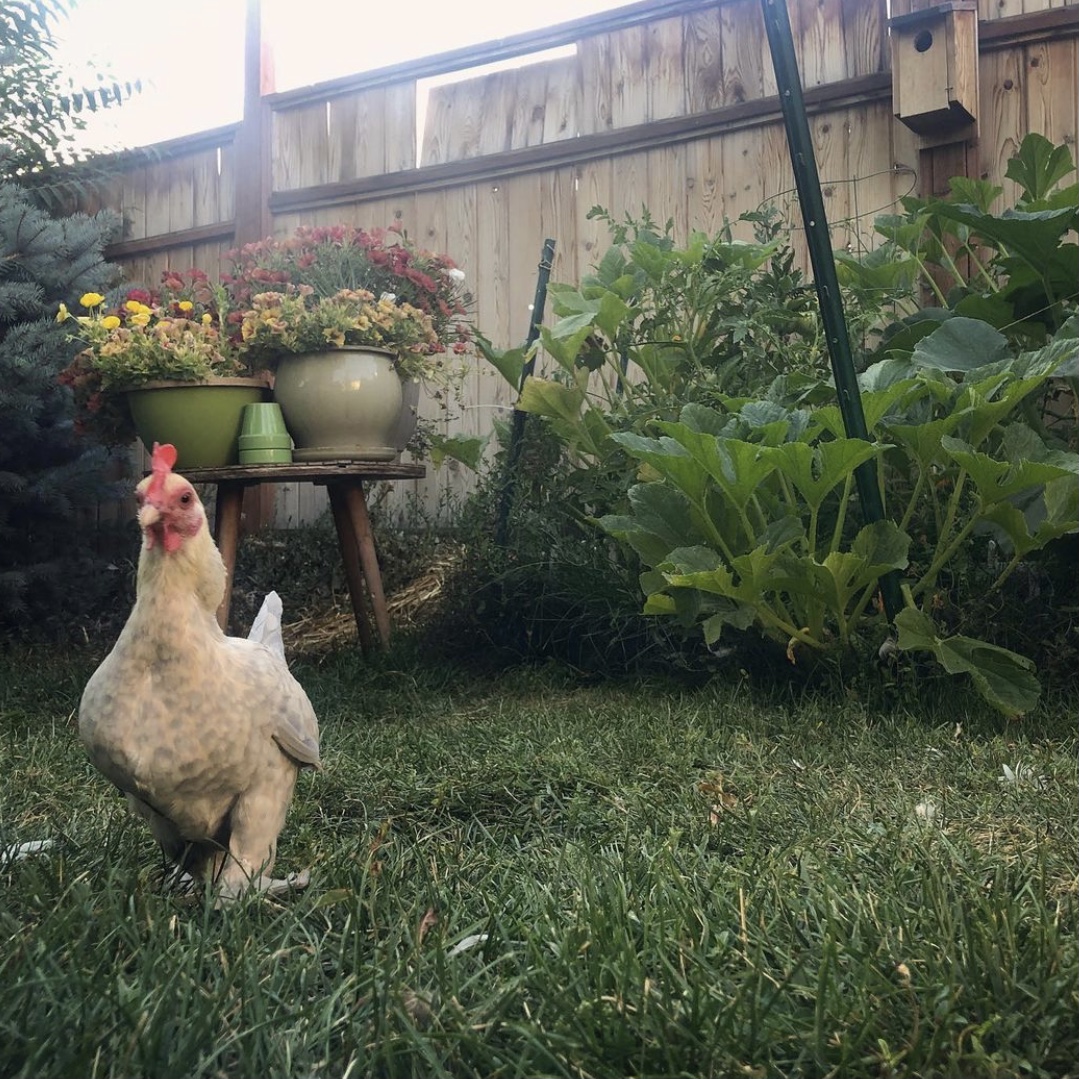
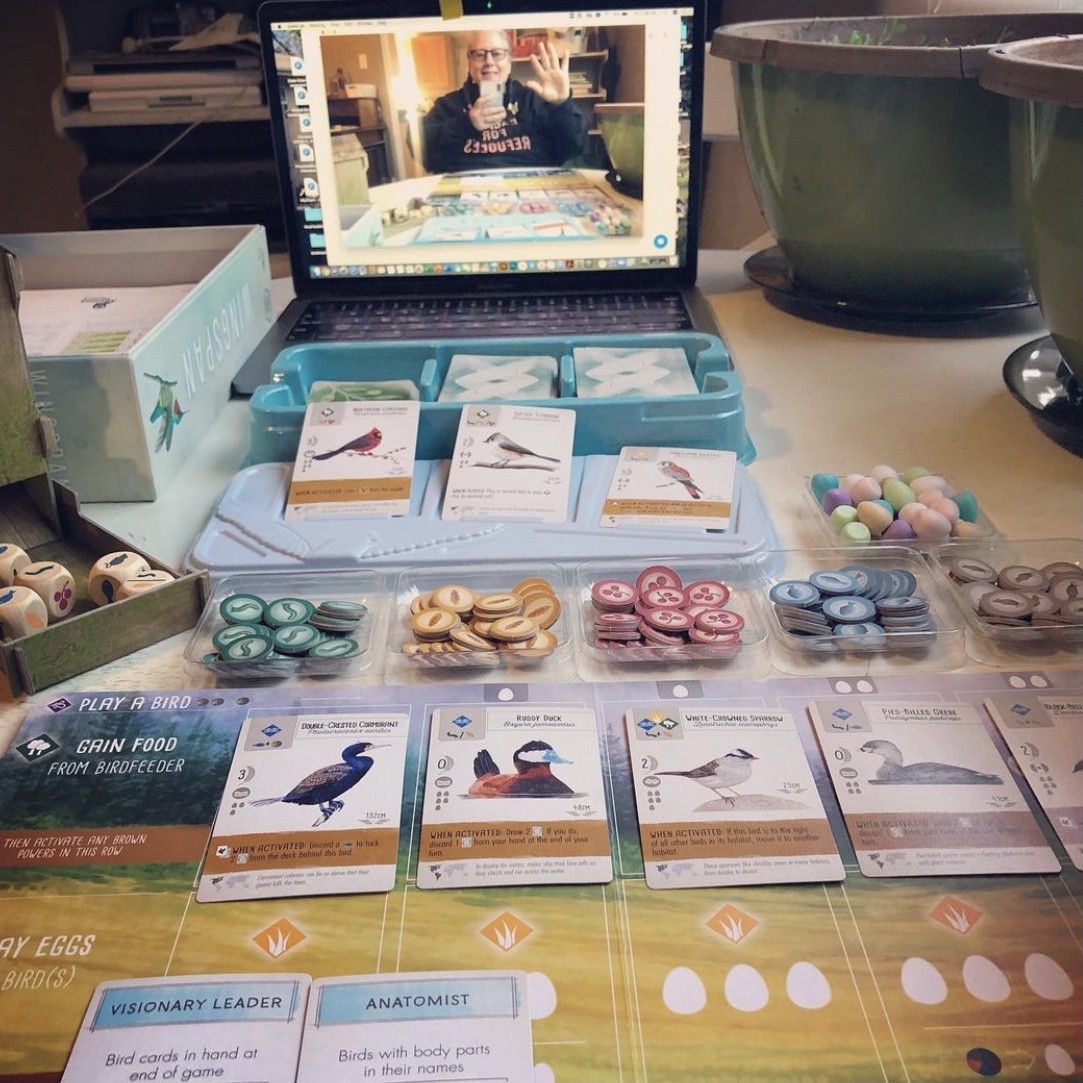
In April, I started a victory garden to grow lettuces, tomatoes, yellow squash, zucchini, basil and parsley. I also started playing the Wingspan board game virtually with two friends, which has been a great social outlet. It’s an award-winning board game featuring birds of the world… just my kinda thing.
I created and shared drawing lessons for kids on YouTube and learned several trending TikTok dances.

In May, with no job prospects and an ongoing pandemic, I decided to just make the best of it and focus on my bird rescue work and wait out the pandemic.
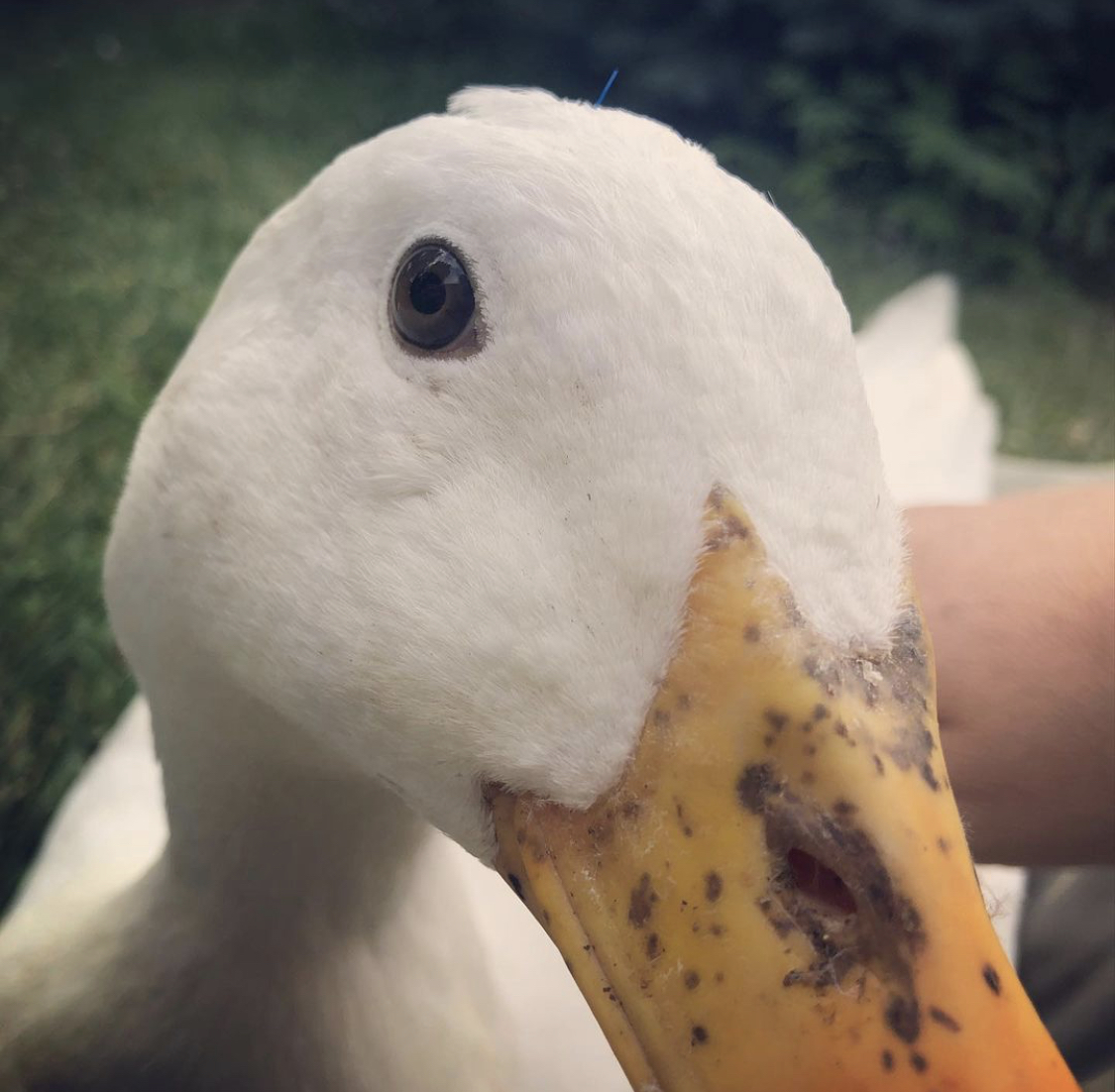
I took in two tough cases, a 5yo duck whose head and eye were badly injured in a raccoon attack and a baby turkey with congenital and/or burn injuries to her eyes. 5 surgeries, $5,000 and 5 months later, the duck is finally healed and doing great.
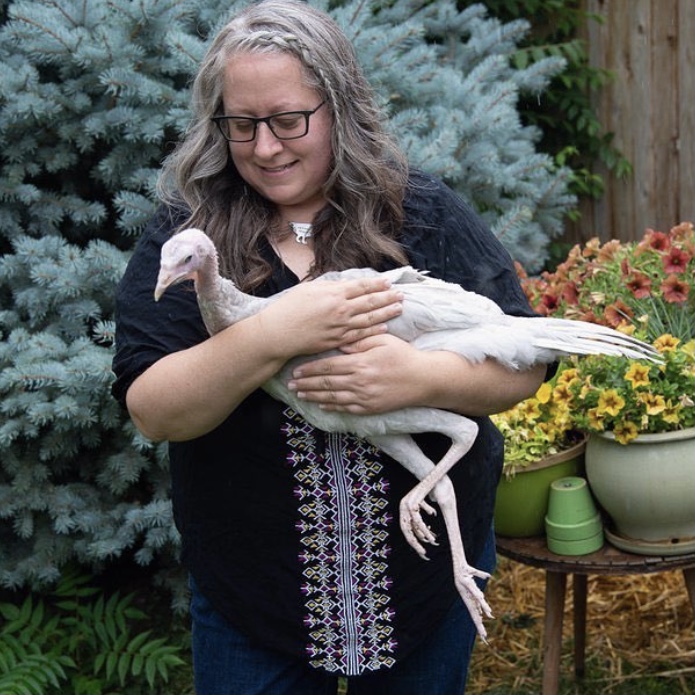
The turkey is doing great but mostly blind, so I am now a designated seeing-eye dog for a turkey. I’m thinking of getting myself a vest that says “please don’t pet the guide dog er… lady, she’s working.”
In June I got very sick with stomach issues and enjoyed a nasopharyngeal Covid test, which thankfully came back negative. My best guess is that I had bad food poisoning from some curbside takeout. I took in two ducks from a family who needed to move because of the pandemic, and I just continued to wonder how long this would all last (spoiler alert: a long time).

In July, I harvested gobs of plums and made freezer jam like a freakin’ pioneer and started eating my home-grown zucchini. I had a nice surprise donation courtesy of Mountain America’s “Pay It Forward” program which kept the ducks fed for two months, and I made some long-delayed improvements to my bird aviary for the flock.
In August, I continued to to enjoy my victory garden, making lots of baked zucchini sticks, ratatouille, caprese salad and vegan fettuccini Alfredo.

My tabletop gaming friends and I added a second game to our weekly Zoom meet-ups, by the same game designer, Elizabeth Hargrave. It’s called Mariposas and it’s about migrating butterflies.
In September, I began looking for a job again. Many of them are remote-only right now, which opened up the whole country to my job search. So far I’ve applied for 52 jobs, had 3 interviews and 2 second interviews. I’ve been lucky to work continuously for so long that my last real job search was in the dot com bust of 2003. So it’s been 17 years since I last searched and let me tell you, a lot has changed. The most obvious difference is everyone interviewing me is now easily 10-years younger than I am. Whee! I’m hopeful that once the vaccine is rolled out widely, the kind of business I do will return and I’ll be able to get back to flying around and meeting people in person. We’ll see. For now, I’m fine.

In October, I made friends with all the praying mantis in my garden, replaced the wood and repainted the A-frame nests in my aviary and perfected my tofu fried chick’n nuggs recipe.
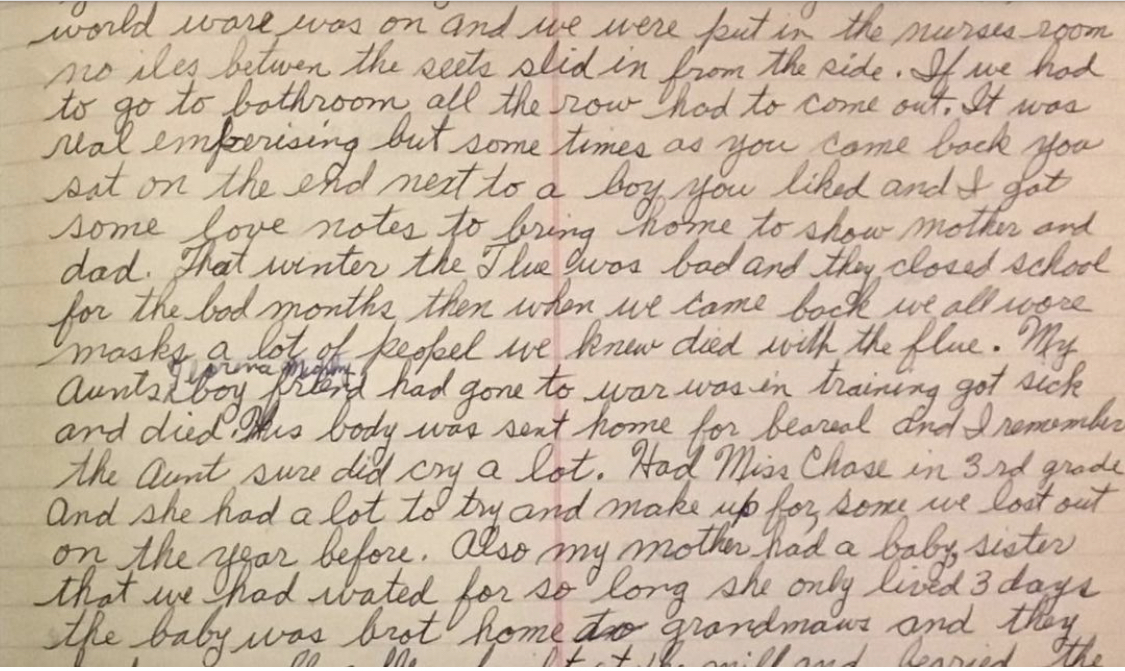
One October day, I happened to read my Grandma Young’s journal to see what she was doing during the Spanish Flu of 1918-1919. It was such a key moment in her life that it’s on the first page of her journal. She was in 2nd grade, World War I was happening and they all missed many months of school and wore masks for many months when they finally returned. They lost friends and family to the pandemic and it took kids an entire year to catch up in school once it was safe to return. Amazing how not much has changed in 100 years.
In November, I spent many days glued to news media following the election and its aftermath, doom-scrolling each and every update for days on end. I also continued my rescue work though I tried to keep them from ending up at my house, instead adopting them out to pre-screened homes and working with several other local rescuers from Ogden to Provo and beyond. I tried to get into two separate vaccine trials, but a recent blood donation and limited exposure to the virus screened me out of contention for both studies. I was hoping to use the trials to get the vaccine early, but it didn’t work out.
And here we are in December. We adopted out and welcomed in several other birds along the way, but these were the key highlights of 2020. Being a real-world introvert and an online extrovert, I think I fared better than most during these tough times. I can stay thoroughly entertained all by myself. With my computer, the Internet, my backyard birds and a weekly board game virtual social group, I have all I need to keep me happy and content. If and when we all return to some kind of new post-pandemic normalcy, I think I’ll still stay 6+ feet away from people, wash my hands a lot and even wear a mask. We’ll see.

I hope this virtual holiday letter finds you happy and healthy, or at least still here and still hanging in there. All the best for a BETTER 2021 for us all!
Love and quacks,
Tiff and the flock
Dumped Domestic Ducks: Highland Glen
Highland Glen Park pond is a typical Utah fishing pond with an unfortunate problem of dumped domestic ducks. Let’s detail the many problems with dumped domestic ducks in public parks and ponds by using Highland Glen as an example.

I’ve labeled all the dumped domestic pet ducks in the photo above. Most of the birds here are dumped. There are domestic rouen, pekin, Indian runner, Swedish, cayuga, khaki, Appleyard, Ayelsbury, buff and muscovy ducks. These same breeds of domestic ducks are dumped at most every pond throughout Utah. You can tell a dumped domestic duck from a wild duck because it is 2-4x larger than a mallard and usually much more friendly. All white ducks in parks are dumped domestic pet ducks. Almost all dumped domestic pet ducks cannot fly.

Why is it wrong to dump ducks?
It’s illegal to dump domestic ducks and geese, against Utah code: Title 76 Chapter 9 Part 3 Section 301. It’s also cruel. These domestic ducks are bred to be so large they can’t fly much, if at all. They need food support and often start to starve in winter when weather turns cold, kids go back to school and no one comes to feed them. In some parks with regular visitors, they get enough handouts to survive. But even then, they’re subject to off-leash dogs, vulnerable to other predators and prone to foot and leg injuries (often from fishing line and hooks). The largest breeds get sick first, because they don’t get enough nutritious food to thrive.
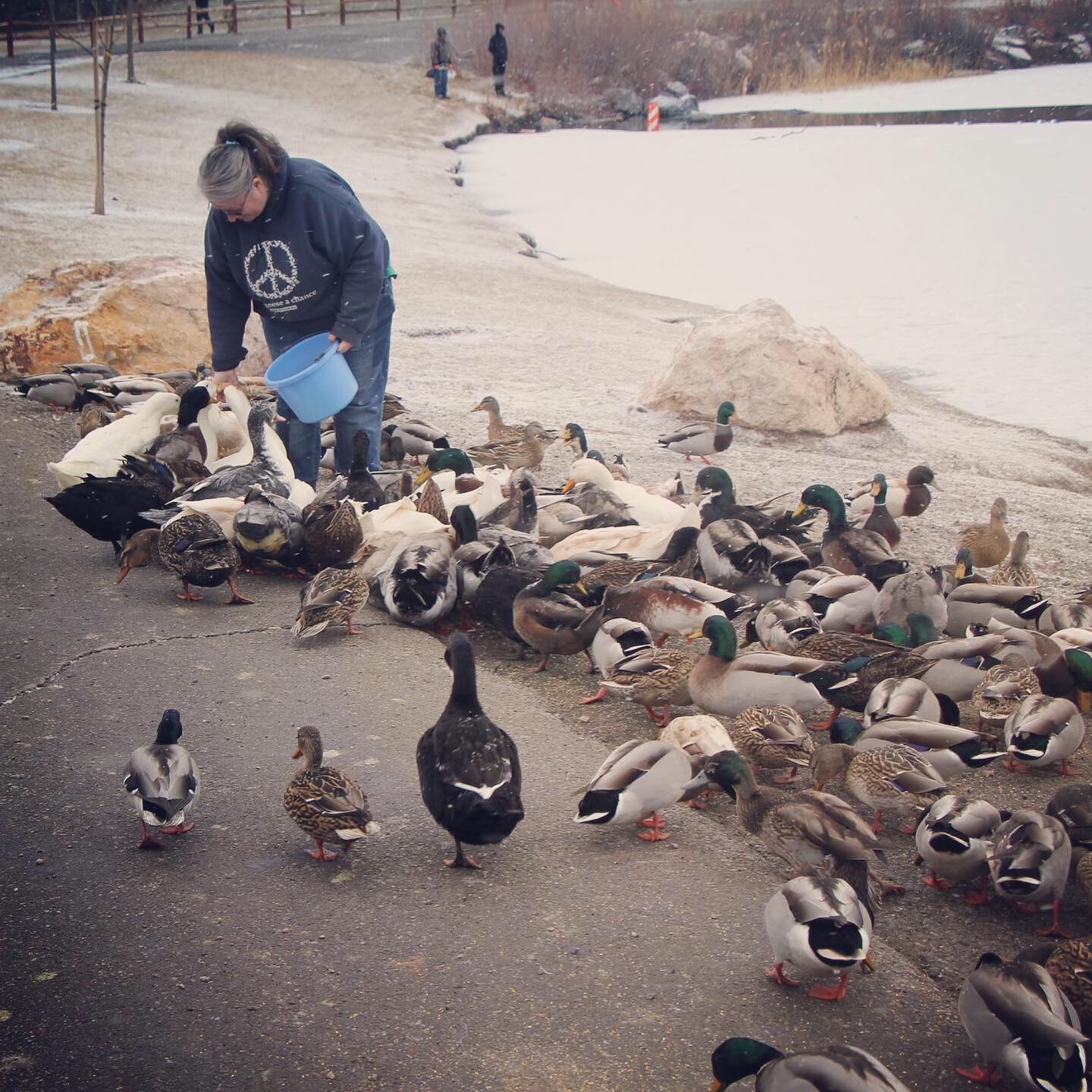
Also, they don’t belong in the wild. They cause overpopulation, they breed with wild ducks to create more manky/half-mallards that take up resources of wild birds, contribute to poor water quality and erode the shoreline and native plants. This past month I visited 5 ponds between Ogden and Provo and counted well over 200+ dumped domestic ducks and geese. Most came running when I offered them scratch grains.
“What’s wrong with the ducks at Highland Glen? They look okay to me.”
Several times we’ve heard the ducks at Highland Glen are just fine. That’s not true. We first heard about this pond in 2016-2017 when a local resident saw two wild mallards that had been shot by arrows. The arrows had fallen off, but the tips were still sticking inside the bodies of the ducks. Both ducks were flighted and we could not catch them. It’s highly likely they died from infection. That same year, college kids dumped ducklings at the pond that they’d bought as a joke but could’t keep. We took them in. The next year more ducklings were dumped, and we took in several. The worst case was a beautiful young Indian runner duck who was very, very sick.

This poor duckling cried and cried until we could get it to the veterinarian the next day. We had no idea what was wrong until the vet took an x-ray.
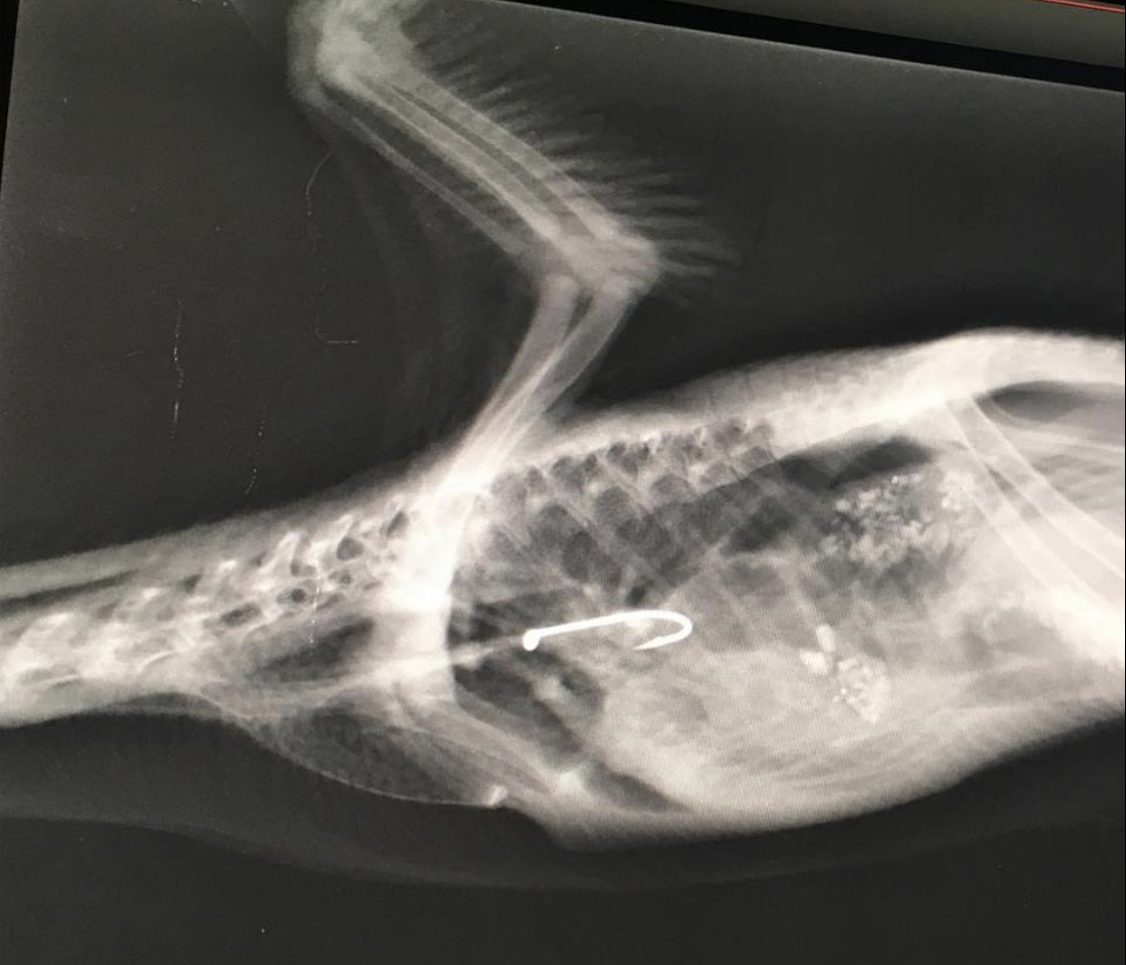
Sadly the duckling had to be immediately euthanized to end its suffering.
We have also taken in three ducks from Highland Glen that had serious leg and foot injuries, most due to fishing line and hooks left behind by fishermen.

Maude was nearly scalped from overmating at the pond, which likely caused her leg injury too.
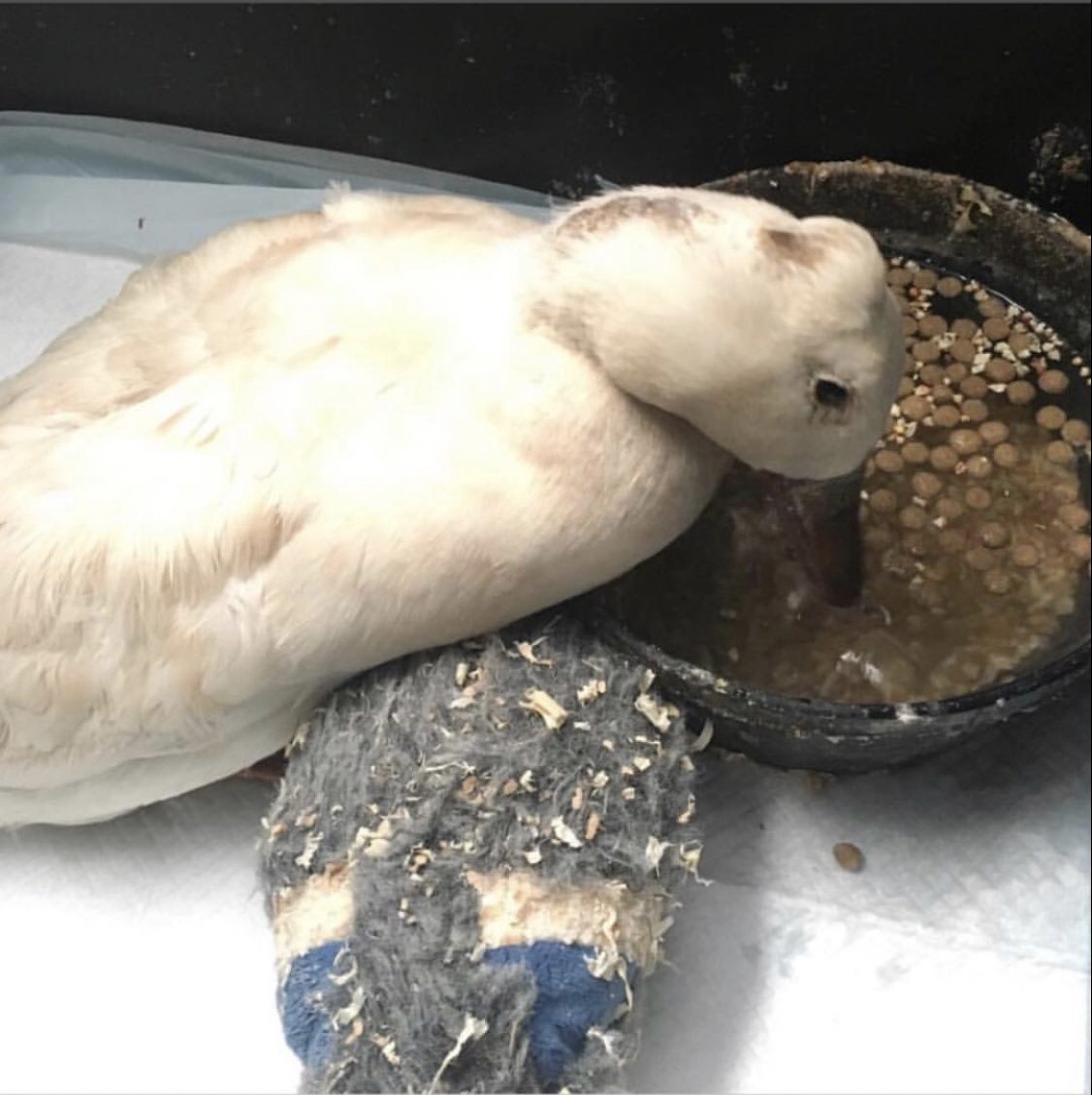
She was in a lot of pain when she arrived, and she required several weeks of treatment to recover.
Kenny was also rescued from Highland Glen with a serious leg injury. Both of these ducks required leg drains, weeks of recovery and rest. They were adopted out together to a safe forever pet home once they recovered.

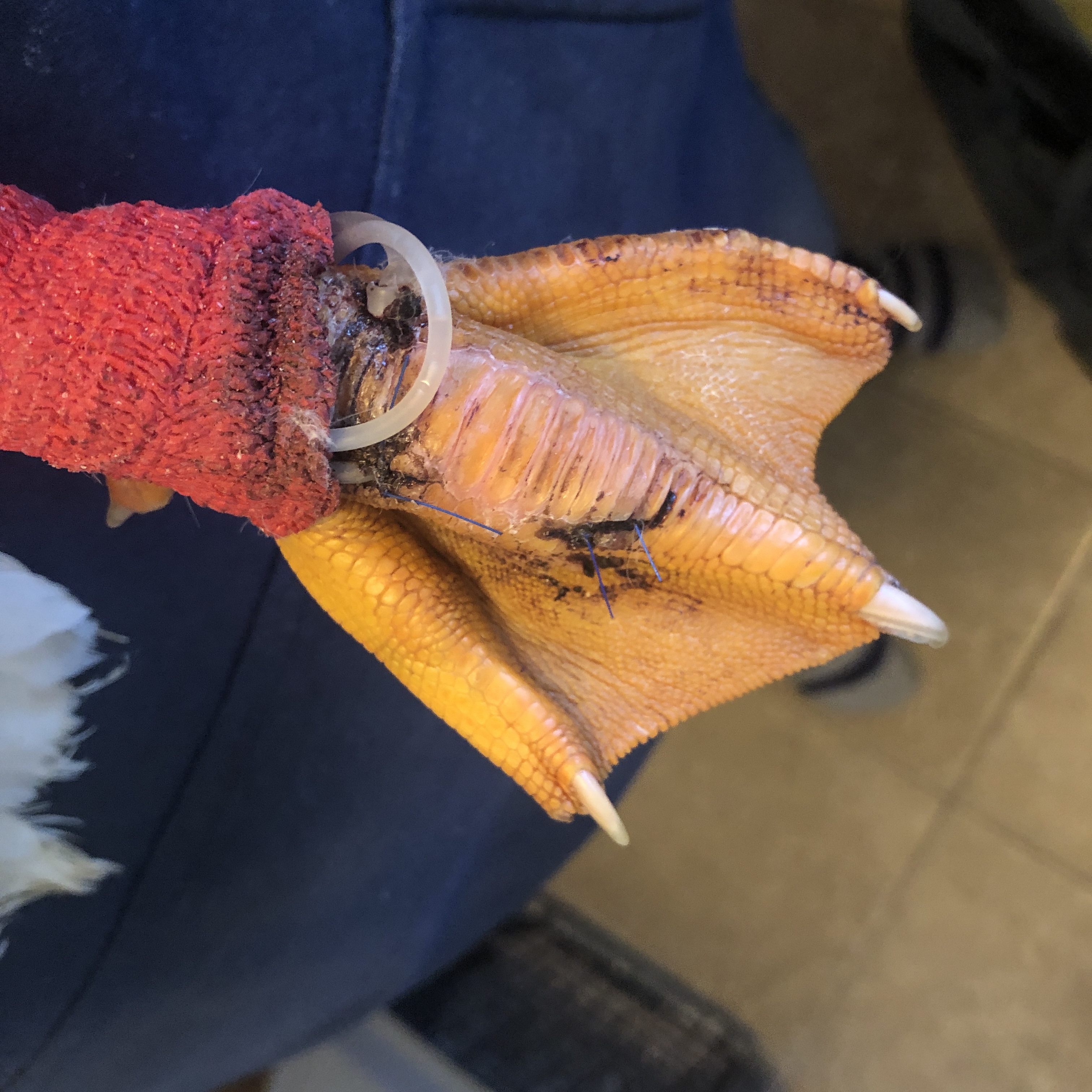
Doogie is a new rescue from Highland Glen who is right now recovering from an infected toe caused by a fish hook.

His toe bone was eaten away by infection, which started higher up where his leg was pierced by a stray fish hook left behind by fishermen.

He has 10 days of a leg drain to flush out as much infection as possible. And then he’ll have antibiotic beads implanted to ensure the infection resolves completely. His vet bills so far total $686.09, for a duck someone dumped at a park like trash.
Two months ago, someone shot a dumped domestic pekin duck with an arrow at Highland Glen.

While she was lucky the arrow only pierced her wing, it broke the bone completely.
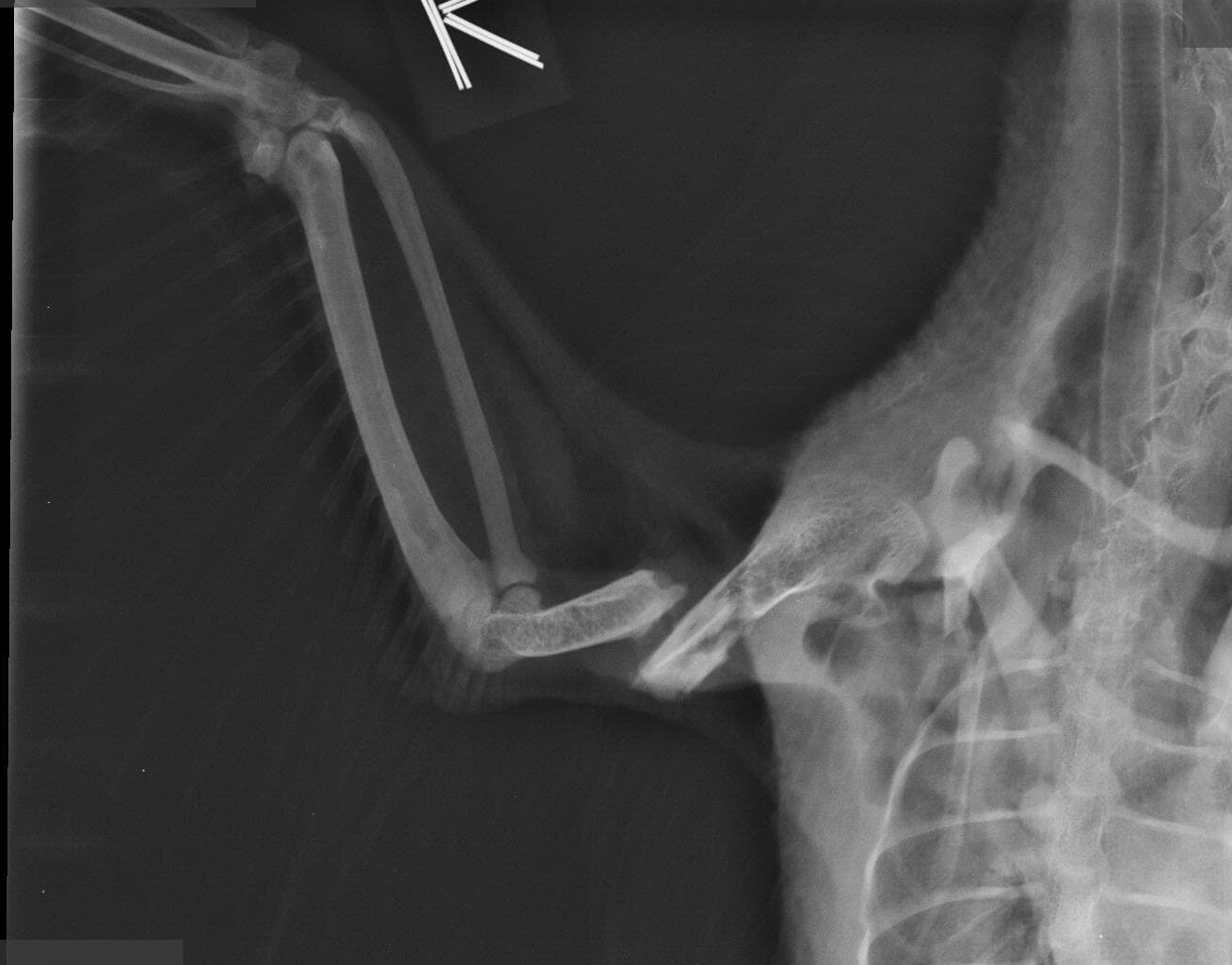
She spent a month in recovery at her foster home, which became her forever home.

Those are just a few of the dumped domestic ducks we’ve rescued from Highland Glen. The wild ducks also get sick and injured, like this mallard hen with a face abscess from a fish hook.

And this sick mallard drake with an eye injury and a leg injury.
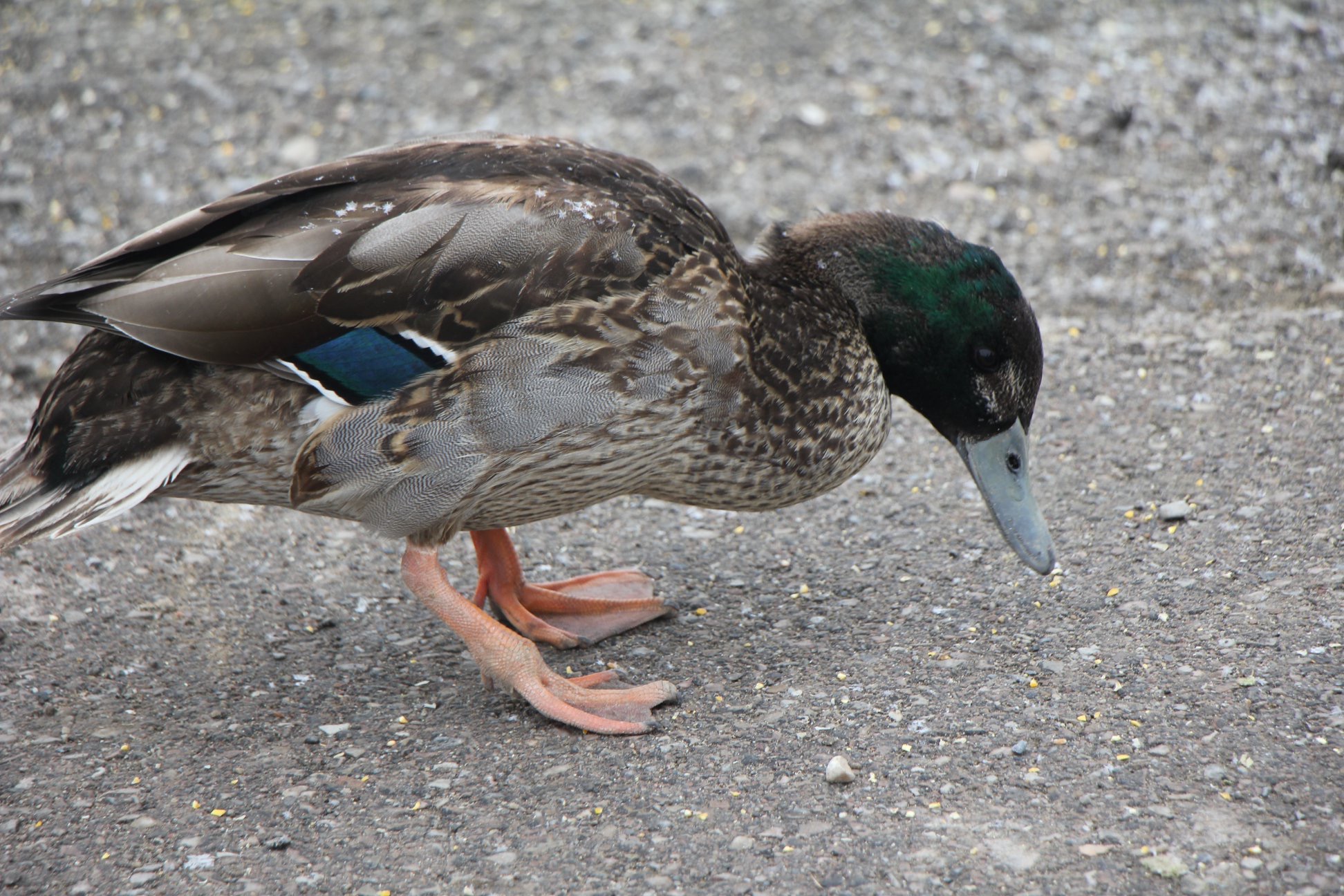
You might think “it’s just mother nature” when these ducks get injured and die. But in the vast majority of cases, nature has nothing to do with it. It’s human negligence and carelessness. It’s completely preventable if people just stop dumping domestic pet ducks and start picking up their fishing line. That’s not mother nature. That’s just common sense and good wildlife stewardship.
“How can I help?”
You can help wild birds and the environment by encouraging people to never get ducks or other domestic birds unless they’re going to keep them for their entire life. Encourage people to rescue birds if they want them as pets. Make people aware that they can never dump domestic pets, even ducks, in the wild. And that domestic birds are a lot of work, and should never be given as gifts or pranks.
You can help the dumped domestic ducks by offering them scratch grains, cracked corn, bird seed or a flock feed. Never put feed in the water as it can contaminate the water quality. Don’t feed more than the birds can completely eat in 5 mins. Place food near the shoreline so they can get back to the safety of open water in case of off-leash dogs or other threats.
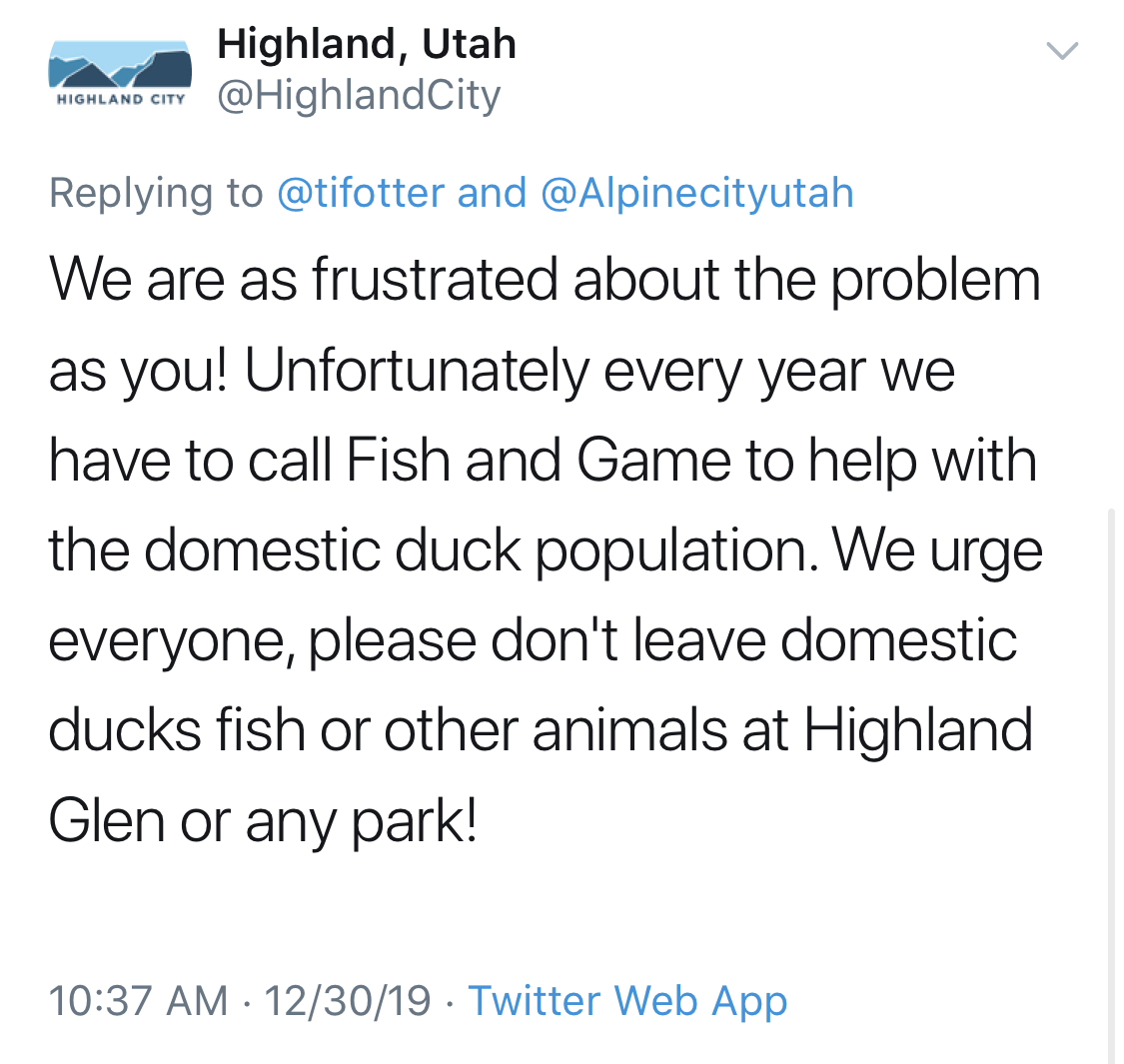
NOTE: Minimize the feed you share with wild birds. If you accidentally feed too many wild ducks it can cause overpopulation. Then they’re all at risk of being culled (killed). Several cities and private entities in Utah contract with USDA Wildlife Services to cull domestic dumped ducks each year, including here at Highland Glen. Isn’t that ironic? So many people think the ducks at Highland Glen are fine. Yet the city contracts with Wildlife Services to round them up and kill them every year.
Lastly, please don’t feed ducks bread. It lacks the nutrients they need to thrive, and it contributes to metabolic bone disease, slipped wing and impacted crop. It also hurts the water quality and contributes to algae blooms and botulism in warmer months. We all fed bread to ducks growing up. But now we know better.
Remember: Domestic ducks belong on farms and in yards with predator-proof pens. They make great pets. But they do not belong in our public parks. Here are a few success stories from Highland Glen. These are the lucky ones.
Kenny & Maude, dumped at Highland Glen, but now in a safe forever pet home.

Costello and Janis, dumped at Highland Glen, but now in their predator proof night pen.
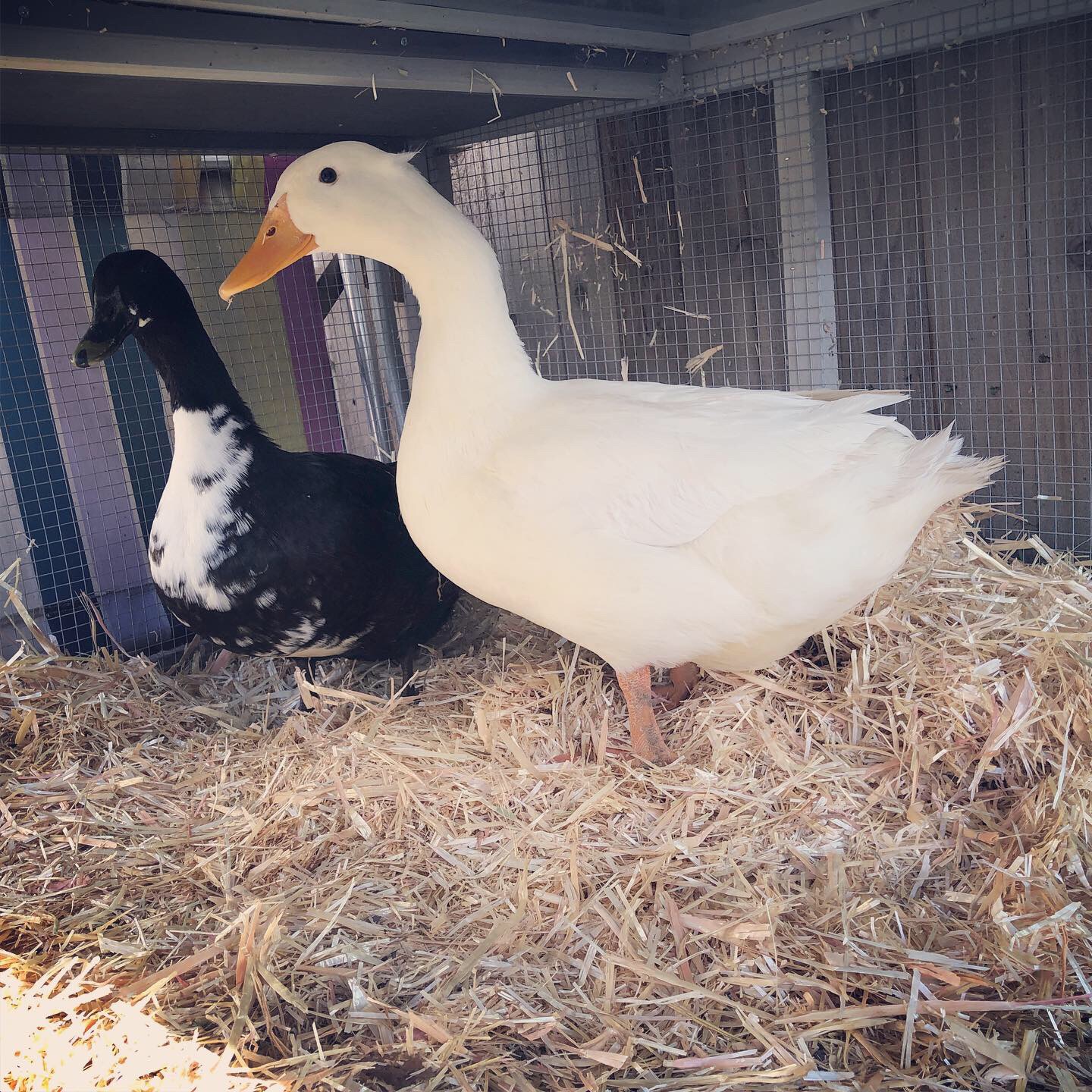
Two pekin girls, dumped at Highland Glen, but now join their new beau Quackie Chan in a safe forever pet home.

Bobbi, dumped at Highland Glen, but now with drake Billy in a safe forever pet home.
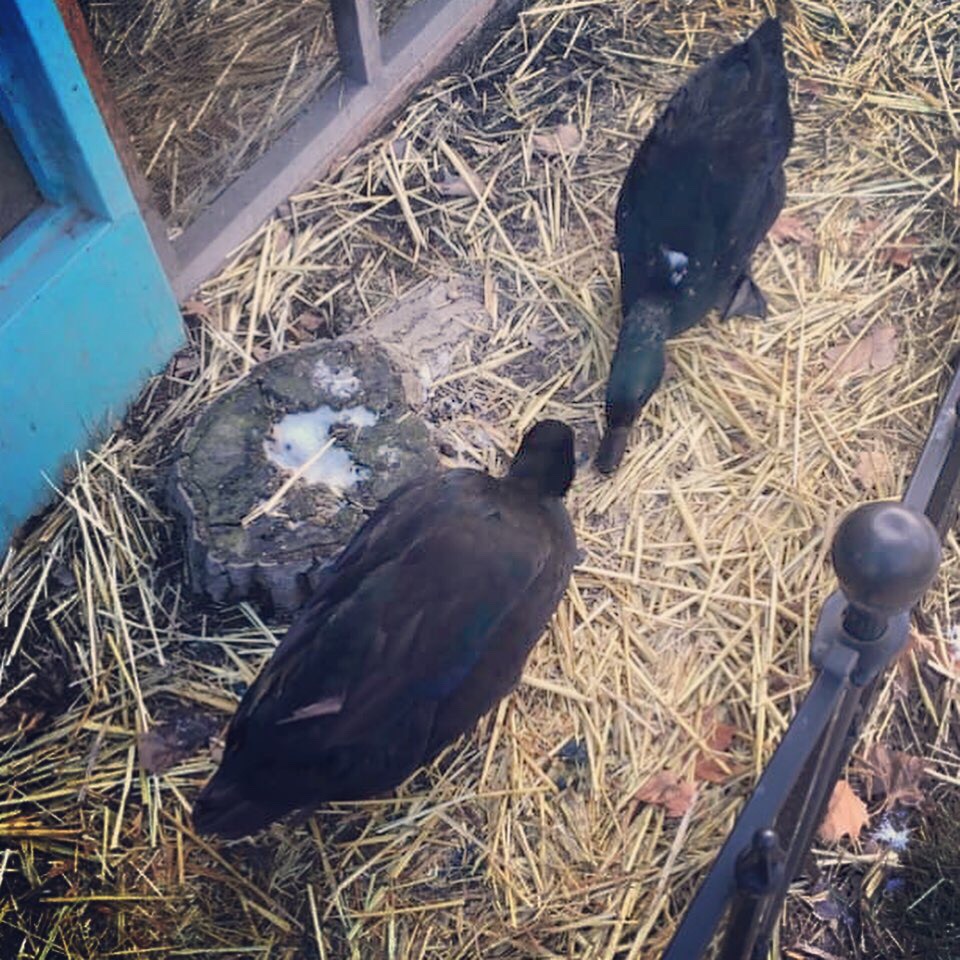
Jeffinie, shot with an arrow at Highland Glen, rescued, recovered and safe now with other rescued ducks.

Special thanks to everyone who helps the dumped domestic ducks at Highland Glen. I’m sure there are many people I don’t know who help, but the helpers I know include Lynnel, Britta, Joanne, Kade, Shannon, the ACO who is there nearly every day and the city of Highland.
Decker Lake Update
UPDATE: We held two clean-ups at Decker Lake and have paused for the winter. Stay tuned for info this spring on future clean-up efforts. We’re also hoping to work with stormwater management to ensure their 5-year plan includes budget for BOOMS to block trash before it enters Decker Lake.
County Council member Aimee Winder Newton reached out to the Salt Lake County Parks and Recreation Director and received this information back:
Decker Lake is a County Park. The lake and water are 100% dependent upon storm drain run-off which means the water quality is not great and it never has been. It is a retention basin, with no water flow in or out besides storm water that comes in. We don’t have a way to regulate or control the water level, basically it’s a retention and settling pond that we have dressed up with walking paths. At this point we don’t have any plans long or short to make improvements or enhancements to Decker Lake.
At this time of year, when the water gets hot, the water and mud start to grow botulism spores on the bottom of the pond which the ducks love to eat. Unfortunately the spores are deadly to the ducks. The water grows the bacteria because it isn’t a high quality body of water, meaning there isn’t a flow in and out to keep it clean and cool. It’s Mother Nature at work. We can’t and don’t control what the ducks eat, the state has jurisdiction over the wildlife and we can’t try to chase them away to eat other food items.
As the temp drops, the water cools and spores won’t grow and the ducks and birds are healthy. I know this doesn’t fix the issue for the bird advocates, but in order to “improve” the water it would be a multi-million dollar project, which is not in our plans at this time. Hope this helps, give me a call if you need more info.
We’re grateful for the information, but have a few follow up questions for Parks & Rec.

In this photo, the water level is low and migratory birds are dying. This was taken when the sick, paralyzed avocets were rescued, but died from botulism.
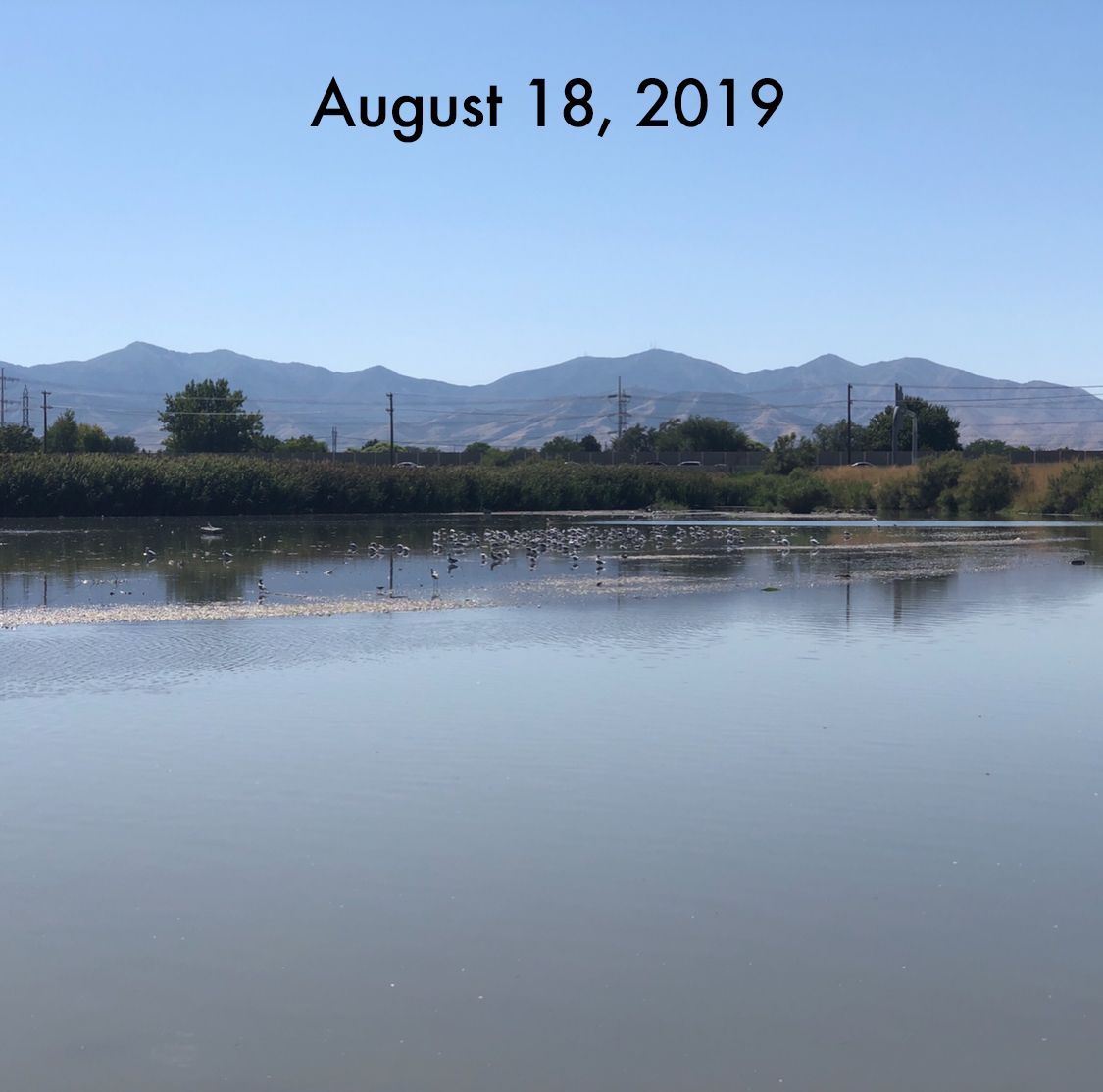
Five days later, the water level had been raised significantly.
In this video, taken on August 18th, water is shown flowing into Decker Lake that was turned on while I was walking by. It wasn’t flowing into the lake when I arrived, but was flowing in by the time I left.
So my open questions are:
1. What, if any, capabilities are there to control water levels at Decker Lake? What are the triggers that result in the water level rising?
2. What party is responsible for regular maintenance of garbage dumped in and around Decker Lake? How often is garbage being picked up at Decker Lake? (Note: One broken white plastic lawn chair has been on the shore and in the water since at least 2018.)
3. What party is responsible for removing dead animals from the water? Who should one call to report a dead animal in the water?
It’s possible the water quality can be improved with simple measures that don’t require a multi-million dollar investment. Can ANY maintenance of trash and dead animals happen at Decker Lake with EXISTING funding for Parks & Rec?
Read previous post about dying migratory birds at Decker Lake.
Migratory Birds Dying at Decker Lake
For a County that Claims to Value the Environment, Decker Lake Sure Doesn’t Show It
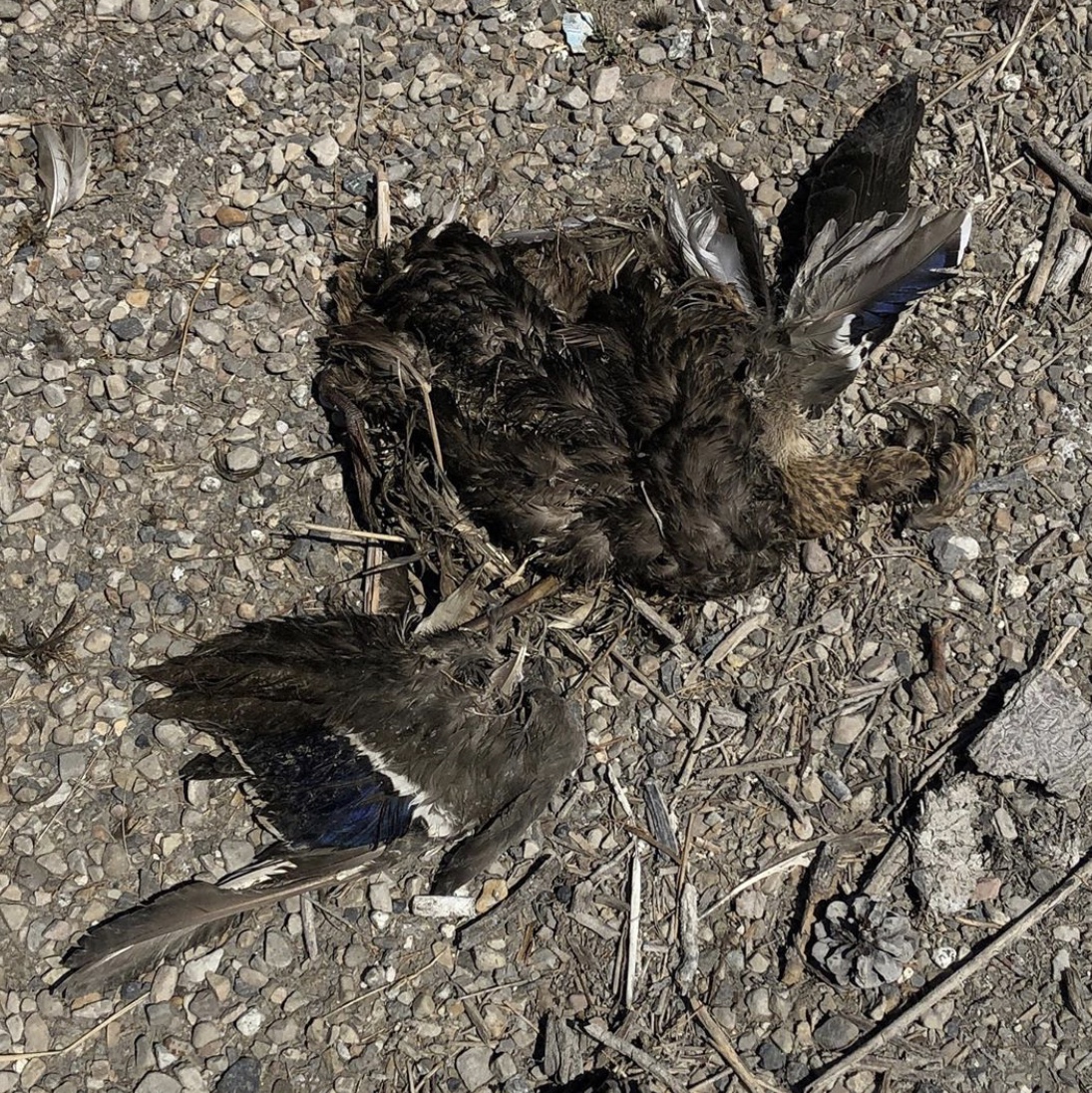
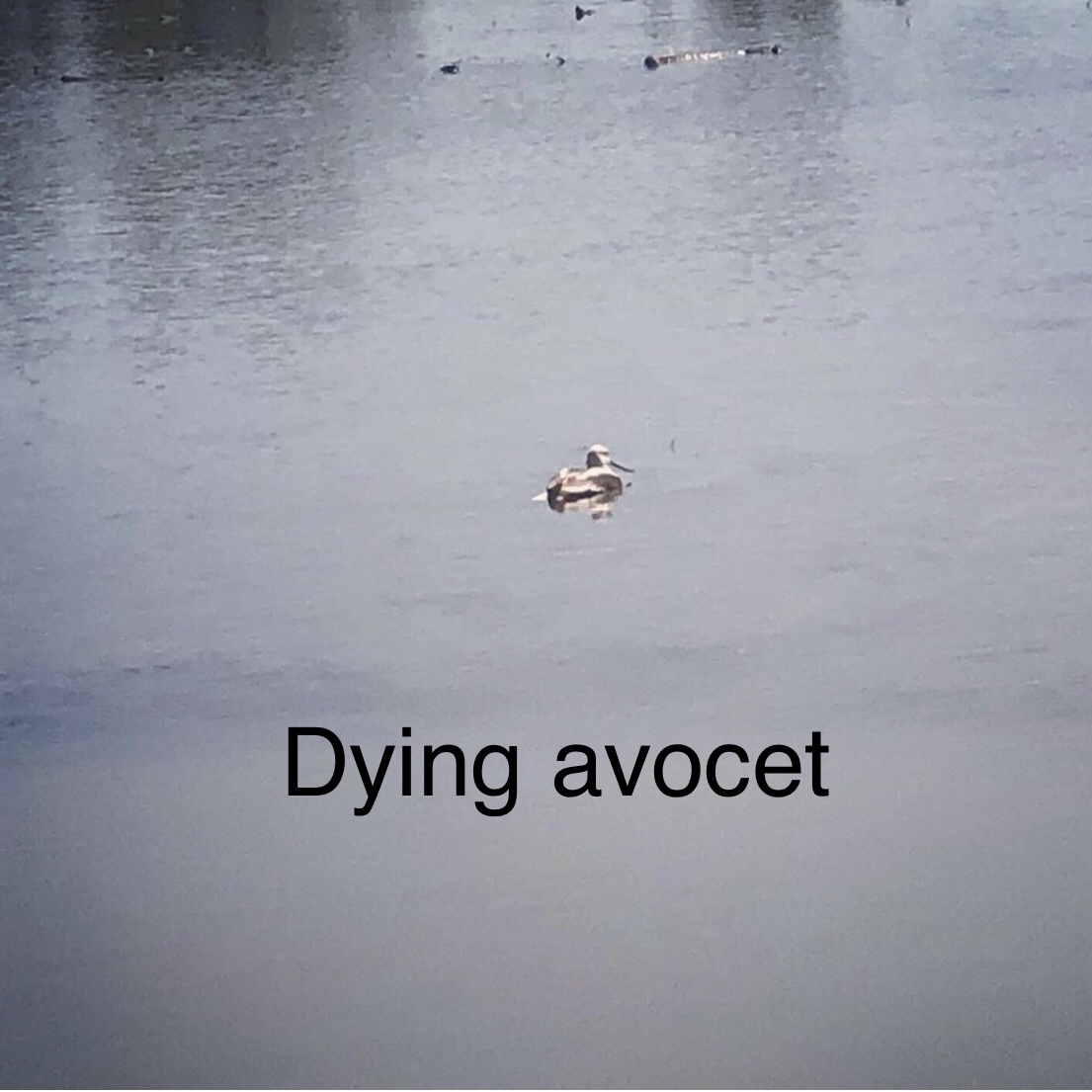
Right now, birds at Decker Lake in Salt Lake County are dying at an alarming rate. Migratory birds depend on the West Valley City lake for food as they move along their migration routes, and current poor conditions put federally-protected shore birds at unnecessary risk. Over a dozen mallards, a great blue heron, three avocets and several dumped domestic ducks have already died.

During the hot August days, our local lakes, ponds and canals naturally suffer a drop in water quality, an increase in algae blooms, and sudden outbreaks of toxic botulism. While these are natural phenomena, they are more preventable and manageable than Salt Lake County officials would have you believe. Botulism outbreaks can be minimized by removing excess sediment from lakes, increasing water flow in hot months, adding aerators to improve water oxygenation and regularly removing garbage and debris from the water.

Signage can also discourage residents from exacerbating poor water quality by throwing bread into the lake for the birds. All of these measures have recently helped Sugarhouse Park pond recover from a botulism outbreak just last August that killed nearly 100 ducks and ducklings.
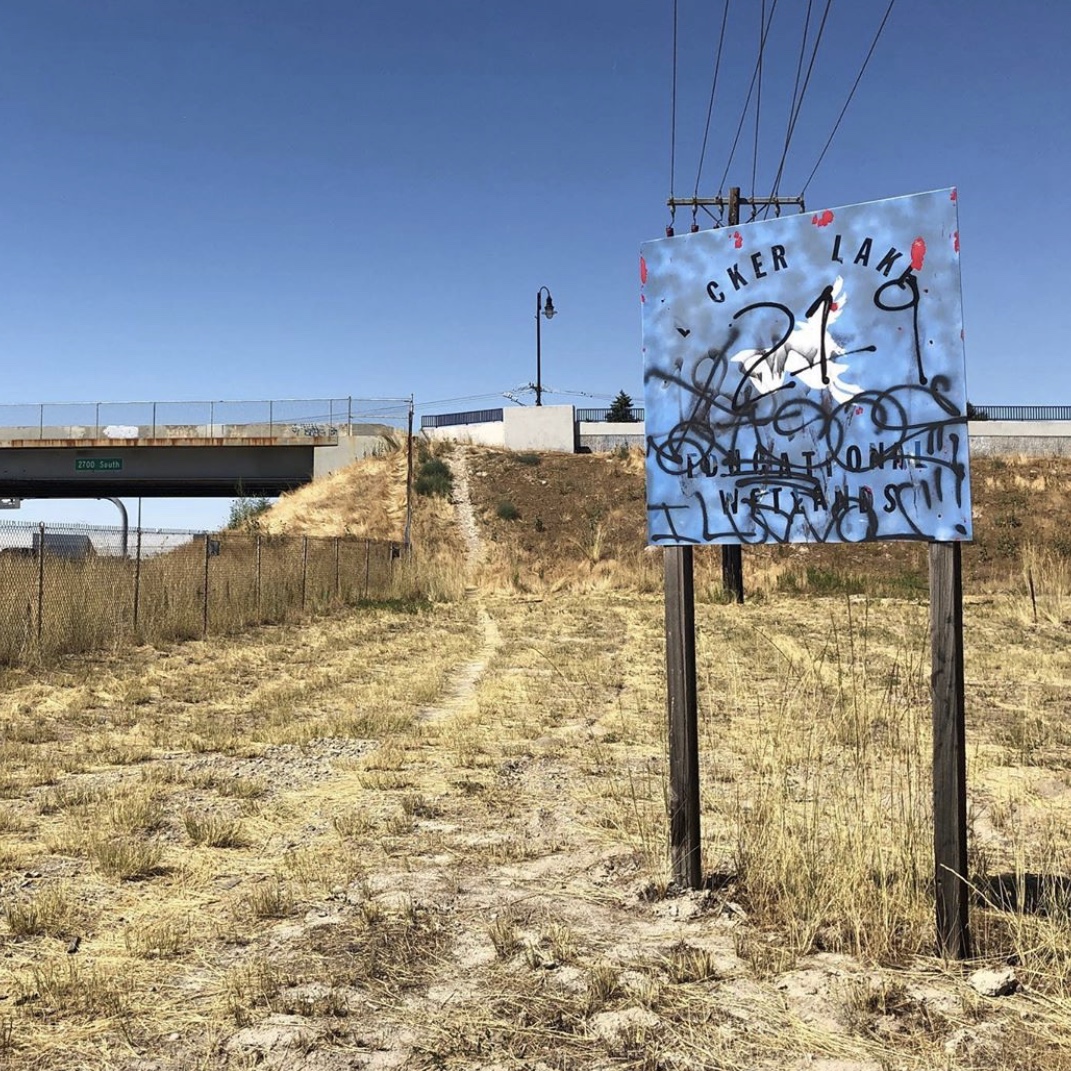
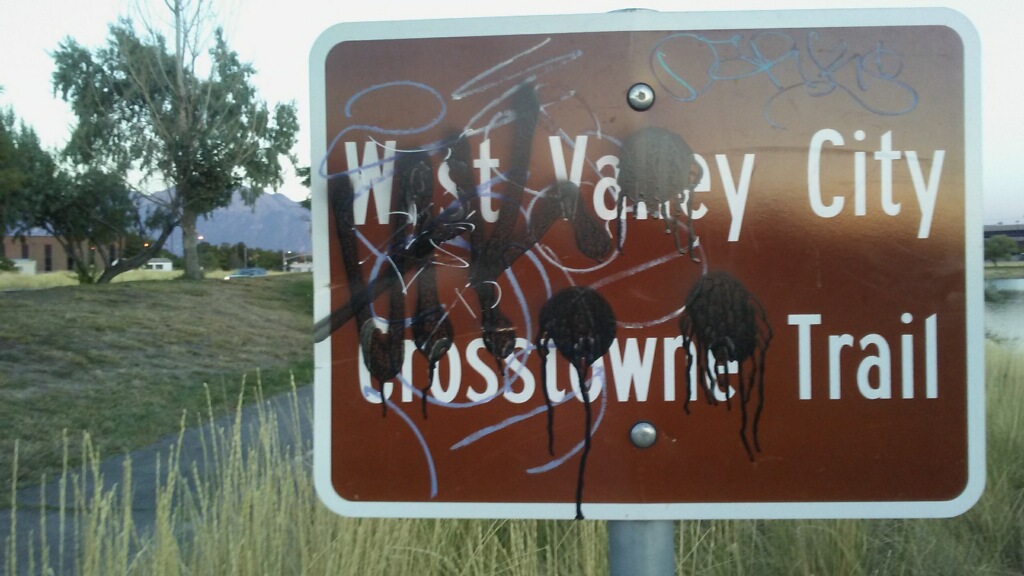
Back in the early 1990s, Decker Lake grabbed the attention of local residents, who—with the help of then Senator Jake Garn—secured $1 million in federal grant money to build Decker Lake into an educational wetlands preserve. Unfortunately, it has now fallen into disrepair through neglect and mismanagement by Salt Lake County Parks & Recreation. What was once a showcase for West Valley City is now an eyesore riddled with graffiti, garbage and dead birds.

Concerned residents who contact West Valley City are told Decker Lake is the responsibility of Salt Lake County Parks & Recreation. Parks & Rec will tell you that any birds involved are the responsibility of the Utah Department of Wildlife Resources. The Utah Department of Environmental Quality will respond and promise to test the water. But that won’t solve the problem or stop the birds from dying. For a county that claims to value the environment, Decker Lake sure doesn’t show it.
This once thriving wetland preserve has the potential to become a showcase community park again. But first and foremost, we owe it to the migrating birds and other wildlife to improve and maintain the water and ecosystem more responsibly. Salt Lake County Parks & Recreation needs to designate budget to regularly pick up the garbage, remove dead carcasses, improve water flow, increase water levels, dredge the lake sediment and more closely test and monitor the water quality—especially in warm months.
As residents and constituents of Salt Lake County, we have the power and the responsibility to ensure our past investments are properly maintained and our wildlife has safe passage on their migratory routes. Please email Salt Lake County Council member for District 3, Aimee Winder Newton, at ANewton@slco.org, and respectfully ask her to “Please prioritize the regular maintenance and improvement of Decker Lake Wetlands Preserve.” Then comment on the Salt Lake County Parks & Recreation Facebook page (https://www.facebook.com/slcoparksandrec/) about the urgency of preventing more deaths of migrating birds. You can also help increase awareness and interest by posting the link to this blog post on your own social media.
Thanks for reading. The migratory birds deserve better from us. Let’s help them out.

Tiffany Young
SL County resident
Neighbor Kitty
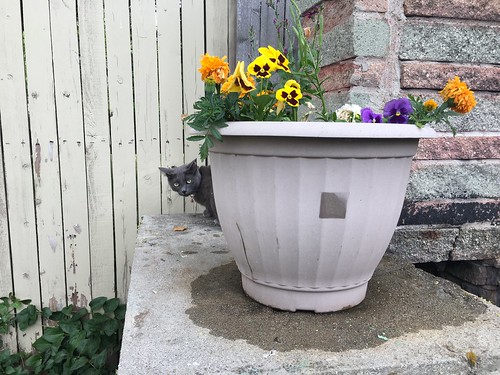
Lately, we have a new kitty who hangs out with the ducks and clucks.
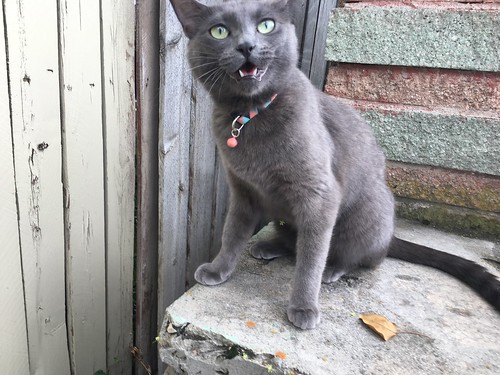
We’re not sure what this girl’s name is, but she loves to chill in and around and on the aviary and watch for rodents.
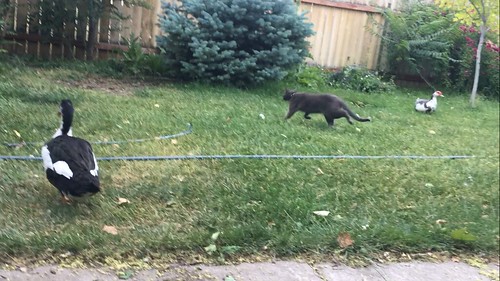 She takes her job pretty seriously, and does a good job. At first, she was hesitant to stick around if I was out in the yard.
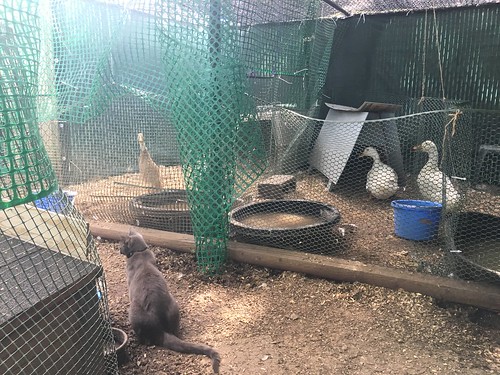
But now she doesn’t care if I’m there, and just goes about her business.
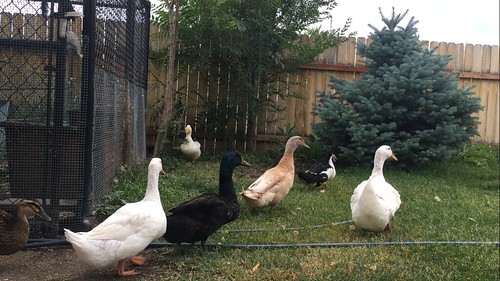
The ducks still aren’t entirely sure what to make of her, but she’s so small that she’s not a threat to them.
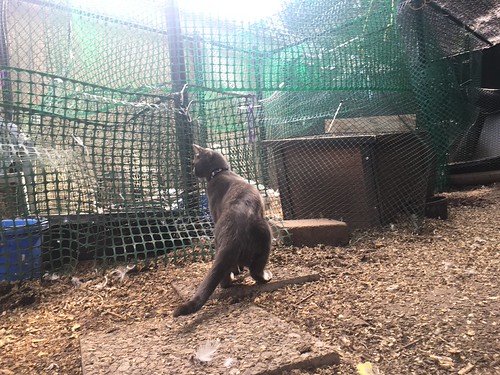
She’s more interested in the little birdies and any rodents that might appear.
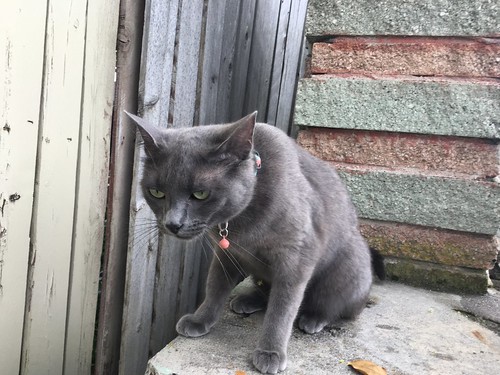
We’re not sure of her name, but we heard from a neighbor that she recently moved here from Kansas.
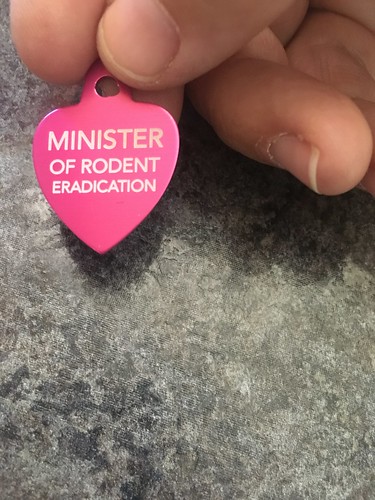
She’s been doing such a good job of keeping an eye on the aviary that I decided to promote her to the position of “Minister of Rodent Eradication.”
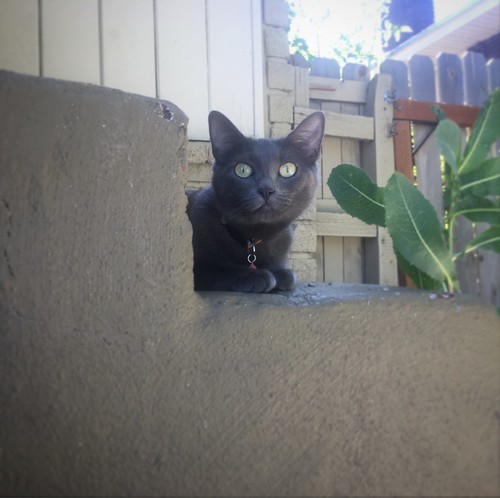
It’s tough to keep good workers motivated, but she’s a self-starter and very driven and committed to her work.
So welcome to the neighborhood, neighbor kitty. And welcome to your people, too.
Now get back to work.
Farewell to Teddy Crispin
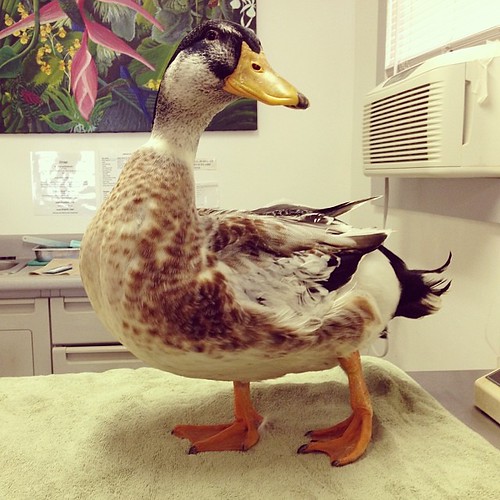
Teddy came to us in February 2014 after being surrendered to our Seattle avian veterinarian. He had a severe leg infection that had gone systemic, and he was so sick he couldn’t hold himself up. Our vet started treating him and asked if we had room to take him in.
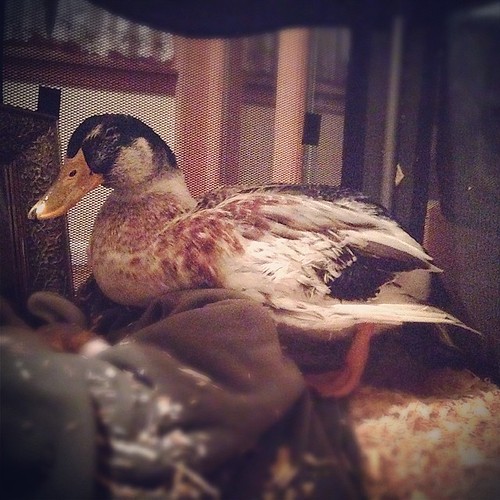
Teddy spent over 4 months on various antibiotics to clear up his serious infection. His leg was never the same, but he recovered well enough to get around and join the rest of the flock. 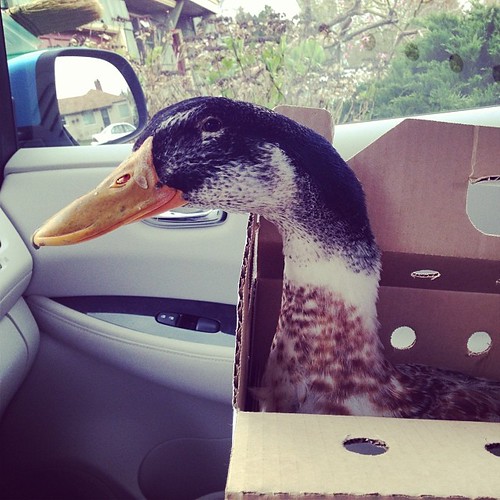
Teddy had so many vet visits that he became pretty friendly and tolerant of people, and he was a really good conversationalist.
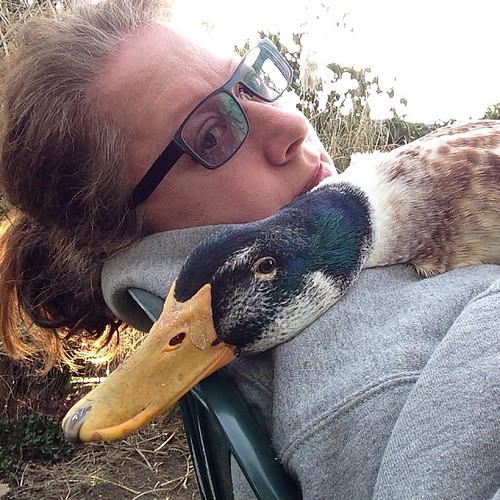
He would stick close to me in the yard while his leg healed, so no one else would pick on him.
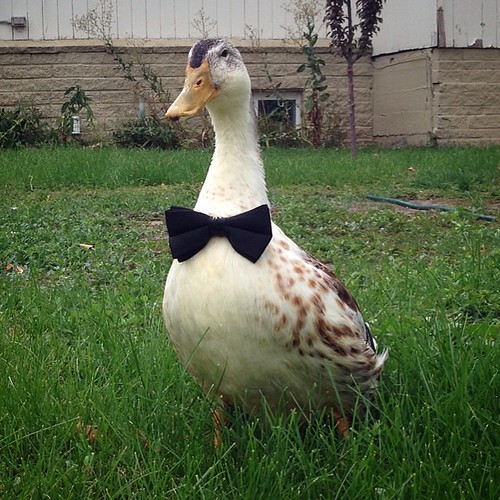
He was also a sharp dresser and liked to impress the ladies.

Originally, Teddy was going to be a foster duck. But a suitable home didn’t come along in time, so he joined us on our journey from Seattle to Salt Lake City.
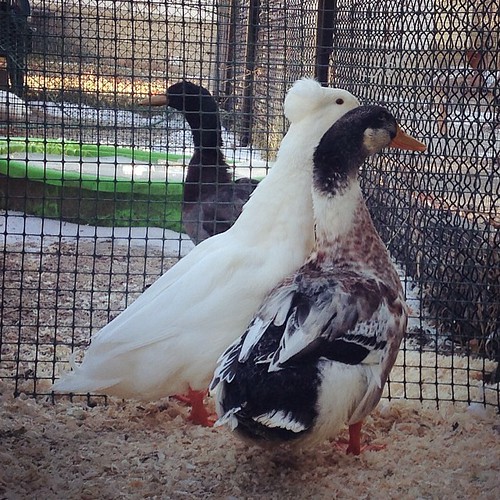
Teddy got along with most all ducks, but he was kind of a push over. We had to be careful of his bum leg, so he couldn’t be placed with all the rest of the ducks. Teddy took in one of our first Utah rescues, Chester Sugarmont.
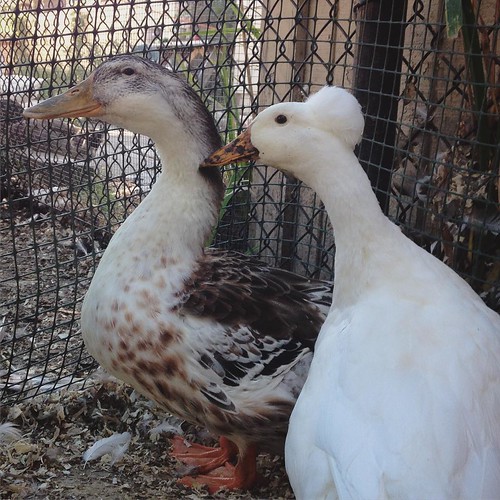
Chester adored Teddy, and became his constant close-talker.
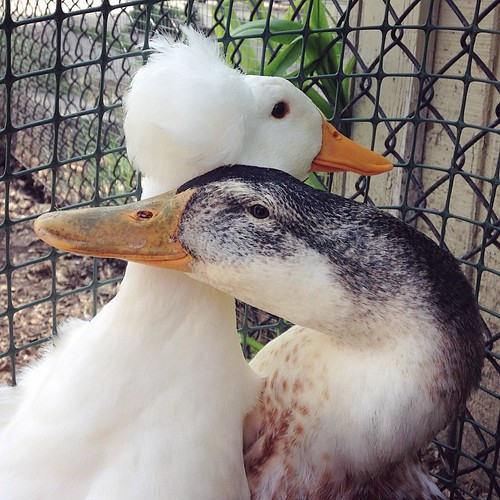
They were good buddies, and Chester was a great wingman, but Teddy’s leg arthritis eventually worsened and he needed a quieter spot in a smaller space.
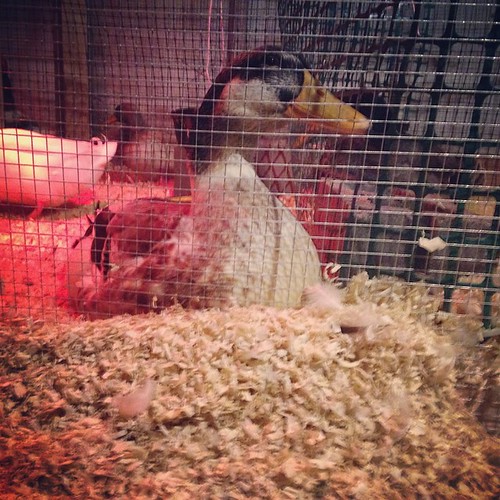
In Teddy’s final year, he didn’t walk much at all. We made sure he could move around well enough to get to his food dish and get to shelter, and he did okay for quite a while like that.
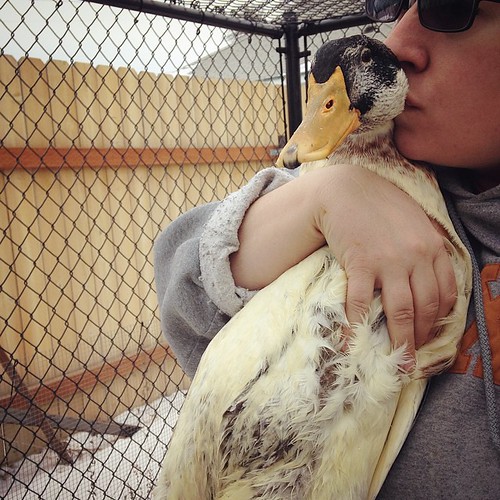
But lately he had stopped walking entirely, and his pain became too severe to manage. It was time to say goodbye.
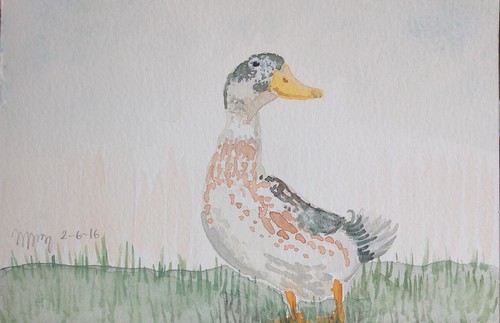
Teddy was a sweet, interactive, kind boy who always did his best to make new rescues feel welcome. He got along well with most everybody, and was a beloved wingman to Chester and later to Little Quack.
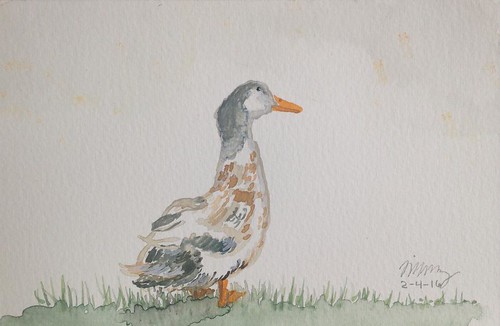
We are sad to see him go, but know he is now out of pain and hopefully somewhere with a new wingman, making him feel welcome.
Rest in peace, my sweet Ted head. We love you.
April 2013 – June 2017
The Story of Joey Goose
On Monday, February 13, 2017, Joey goose passed away at the veterinarian’s office. His passing was quite a surprise and definitely caught us off guard.
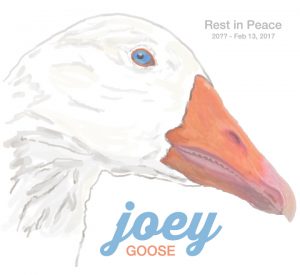
On Thursday he seemed his usual self. He had fun breaking in my new rain boots by testing their nibble tolerance.
On Friday he seemed fine as well, but he didn’t eat all his dinner, so I made a point to watch him closely on Saturday. (Ignore the mating dorks in the foreground).
On Saturday, Joey got up normally with his posse of ducks and ran out of the aviary, honking as he usually does. He swam and played and nibbled at the grass, but he didn’t eat much. I brought him romaine lettuces, which he usually loves, and he just mouthed at them. So I called the vet and made an appointment for Monday morning, just in case he didn’t bounce back on his own. Then I went and bought him some of his favorite no-salt top saltine crackers. When he wouldn’t eat a saltine, I knew something was definitely wrong. He was calm and talkative, and he let me bring him into the house and set him in a playpen for the night. All day Sunday he continued to decline. I was in a panic trying to figure out what was happening. Did he eat something bad? Does he have something stuck in his crop? Is it an infection? Is his digestive system blocked? When the vet’s office opened on Monday we rushed him in. I carried him into the back office area and we set him up in a bank cage/pen on some towels so they could prep an IV. He passed away before they even got a chance to evaluate him.
It was such a SHOCK to see him decline and pass that quickly. But birds are experts at hiding their symptoms. I requested an autopsy which took place this morning, Tuesday, February 14th. While it wasn’t conclusive, it did rule out many things. Joey didn’t have a blockage of any kind. He hadn’t eaten any foreign material or metal. Joey didn’t have inflammation or signs of cancer. He didn’t show signs of a contagious disease that might affect the rest of the flock. The only clue was that his liver was small and hardened. That implies that he might have had long-term liver disease, which is unfortunately very common in domestic birds and very difficult to notice early. It’s also not very treatable, since it isn’t usually noticed early on. It just happens. Joey did spend several years at area parks before his rescue, where he was fed mostly bread. That diet could have contributed to liver problems, even though he had a good diet in his last two years. We also don’t know how old he is, but have heard he spent “many years” at an area park.
Back in October, I rushed him to the vet when he was stumbling a bit. I felt like he was really “off” then, but his blood work and exam didn’t show anything obvious, and he recovered on his own. In retrospect, it’s possible those symptoms were also liver disease. We won’t ever know for certain, but it seemed to be a natural death process over several days for him, and we ruled out an acute event like a blocked digestive tract or a wound or such.
So he’s just… gone. I’m still trying to wrap my head around it. If I know a flock member is going to pass naturally, as Petunia did of old age, it is often quite peaceful. But when a kid like Joey, who I have no reason to suspect is ill, is suddenly declining, it makes me frantic. On the plus side, Joey seemed at peace and comfortable. I just didn’t know what was going on, and didn’t expect it, so it was pretty traumatic. Late Sunday night to Monday morning, I started to feel it was too late to save him. I got up at 1am and drove around, trying to rack my brain and figure out what was happening to him. It breaks my heart to see him go when I thought he’d be around for years to come. But that’s just how it goes sometimes. It’s almost 2-years to the DAY of his rescue, so we’ll try to pull it together and share his wonderful life now, instead of dwelling on his death. I’m still in shock and miss him terribly, but he deserves a proper farewell.
This is the story of Joey goose.
We first met Joey in February 2015. He had been shot along with dozens of other wild and domestic birds at a family rescue pond in Orem where he lived. Here’s a video of Joey with his buddy Lumpy after he was caught and held for rescue:
He was bonded with a Chinese goose and many people believed them to be a couple. They were known as Romeo and Juliet, or Lumpy and Penny. For years, many people thought Joey was a girl (Juliet/Penny). He was dumped at Wheeler farm years previously and Lumpy the Chinese goose became his buddy. They were mistaken for a couple because Joey LOVED to help raise other birds’ ducklings and goslings each spring. We heard conflicting reports that Joey was originally dumped at Decker Lake before being moved to Wheeler Farm. Eventually he was moved to Clegg Pond where he and so many others were shot. Here’s a news story from that time: http://www.ksl.com/?sid=33419364&nid=148

Joey had been shot six times with lead pellets. He had pellet fragments in his face, tongue, wing, chest, tail and leg.
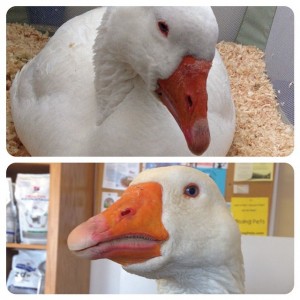
He looked terrible when he arrived, but a few days after surgery to clean up his face and tongue and remove the pellet from his leg, he stabilized and started to improve.

The pellet removed from Joey’s leg damaged his tendon, and he had a previous broken toe injury that made it hard for him to walk.
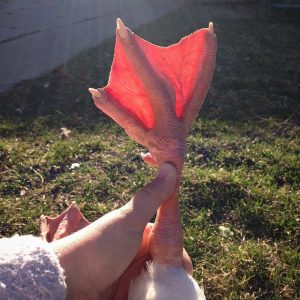
He sat through twice-daily physical therapy for four months until he could finally walk well.
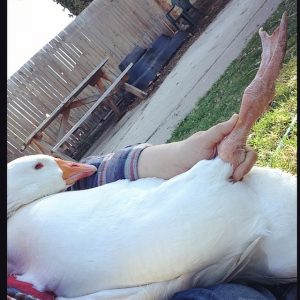
He wasn’t too friendly when he arrived, but after 240 physical therapy sessions, he couldn’t help but start to like me a bit.
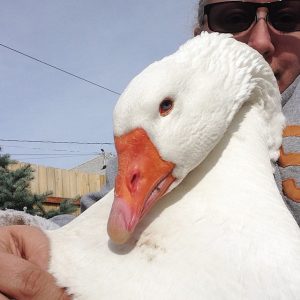
I think he even started to enjoy physical therapy.
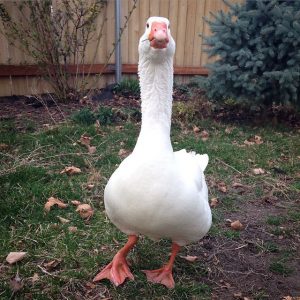
Once Joey’s leg had recovered enough for him to get around well, he quickly rose to head of the flock.

He then appointed himself as Chief Security Officer, or “Mall Cop.”

It was a job he took very seriously. His responsibilities included making sure he knew where everyone was at all times. Making sure no one went anywhere he didn’t approve of, and sometimes beak punching ducks or chickens if they misbehaved.

It was a lot of responsibility, but Joey was a natural leader.
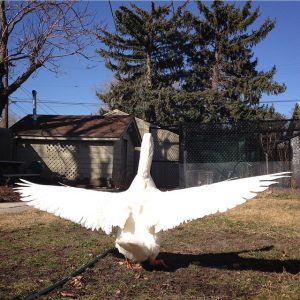
Mall Cop ran a tight ship, and everybody knew better than to cross him.
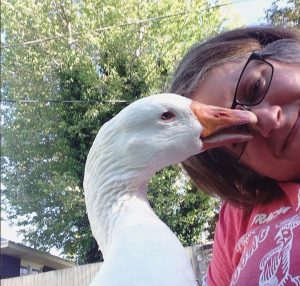
Sometimes even the people needed a beak punch to keep her in line.
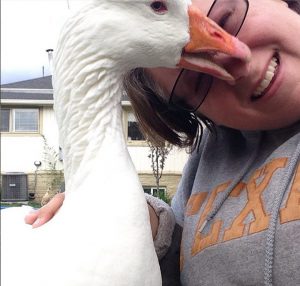
Okay, a lot of times.
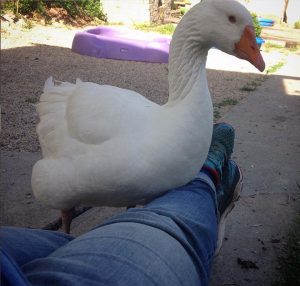
But I knew Joey loved me.
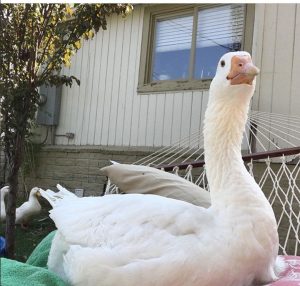
Eventually he would sit with me on the hammock and let me pet his neck ruffles.

And eventually he didn’t have to beak punch me anymore to keep me in line. Maybe just a little tap now and then.

Joey would listen closely as I told him what a brave and wonderful goose he was, what a responsible and capable mall cop. I would lean in and whisper to him “I love you, big goose.”

As mentioned before, Joey loved to raise ducklings. He would protect them from the rest of the flock and keep them safe. Sometimes he even tried to keep them safe from ME, and he would get VERY ANGRY if I would take them away to put them to bed in the house pen. Joey would HONK OUT LOUDLY IN DISAPPROVAL! “THE PEOPLE HAS TAKEN MY DUCKLINGS THAT ARE RIGHTFULLY MINE AND NOT HERS!” When the next morning came and he saw his ducklings again, all would be forgiven.

In just the past year, Joey goose helped raise JJ the mallard, Steve & Eydie, Charlie girl and Libby ducks.
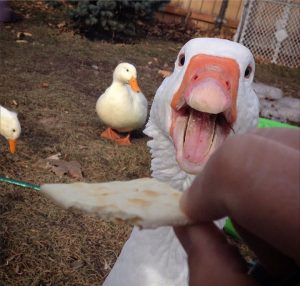
The only thing Joey liked as much as raising ducklings was crackers.

Lettuces are great and part of a balanced goose diet.
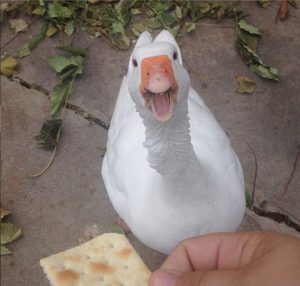
But the rare treat of a single cracker really made him smile.

Joey goose was not a rescue we were expecting, but he was a wonderful surprise.
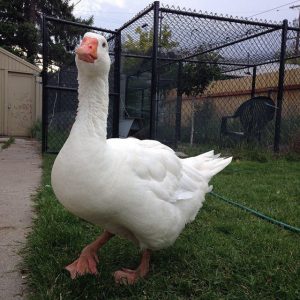
Through the years, many people have loved him by many names, from Penny and Juliet to Pumpkin and now Joey.
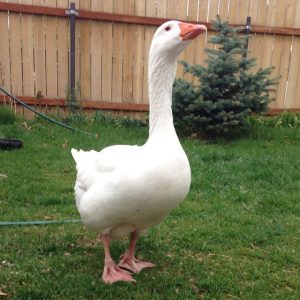
He touched a lot of hearts with his big personality, and I know a lot of people will miss him.

He was a beautiful, sweet, bossy, silly soul and I just hate to see him go.
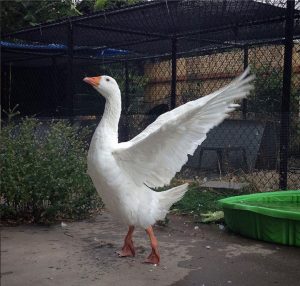
While it’s difficult to say goodbye, I’m also grateful to have had to chance to know Joey and care for him over the past two years.
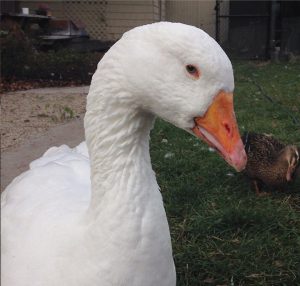
His big personality will be so missed here at Ducks and Clucks.

Rest in peace, my boy Joey. I love you, kid.
Social Media Mayhem
NOTE: This is a long post, so grab a cup of tea or a martini and get comfy. Also, this post includes one or more graphic images. So read at your own risk.
A few days ago, our lovely Petunia passed away naturally and peacefully of old age. She had been living on a heating pad most days for the past year since she couldn’t regulate her body temperature well. She also had pretty bad arthritis. She couldn’t get in and out of a pool on her own, and she needed extra protection from most of the flock. Right up until her last two days though, she was chipper and active. Though we were sorry to see her go, she had a long life, well lived. So we can’t complain.
When I shared news about her death online, some people seemed shocked. This surprised me, as she was pretty much touch and go for the entire last year of her life. So I thought I’d better share a post about the next two rescues that I guessed might be most likely to have issues in the future, just so no one would be surprised if they passed on.

I shared this post about Teddy and Demetra. Both of them are pretty severely handicapped. In the post I noted that if, in the future, they became distressed and their distress outweighed the joy they had, it would be time to say goodbye. I talked a little bit about quality of life, blah blah blah and that was it.
One lady, whose profile said she was from Romania, saw the post and asked me to please consider giving sweet Teddy a lower food dish because his dish was obviously too high for him and it was important to care for him properly. I responded to her, noting that if you look closely, you can actually see a lower food dish to the very left of the photo. Teddy likes the higher food dish, but he can choose between a lower one and a higher one. She wrote back saying she can’t see well because she’s 60% blind and was just trying to help.
Blink blink.
These are my least favorite kinds of comments: The people who view 1/30th of a second in the life of one of our rescues and decide that they alone are the sole champion and defender of what’s best for our bird. They are the magical savior who has seen 1/30th of a second out of the 84,000 seconds in a day, and they know what’s best! I MUST LISTEN TO THEM! THEY ARE ALL KNOWING! And then they start arguing and advocating for the rescue strongly. The idea that someone online, who has never met my rescues, is not an avian-certified veterinarian and who is looking at a photo I took, which represents 1/30th of a second of time… the idea that they know best is absurd. It’s actually offensive to me. And yet I am expected to respond respectfully and explain myself, explain every detail of my care of the rescue, often rehash that rescue’s entire history, until they are satisfied that I have provided appropriate care. Because they saw a photo. And they have some unsolicited advice for me.
Meanwhile, another lady on Instagram mis-read or misinterpreted the post about Teddy and Demetra, and made a bunch of assumptions that I was going to kill Demetra immediately. She posted 4 comments on the Instagram version of my post, including one that said “I have half a mind to drive cross-country and take Demetra.”
I had started answering her other comments and then I came across that one. I felt threatened by it and decided to just block her completely. She seemed unhinged. Her comments were way out of the norm and not a single other person responded to my Teddy and Demetra post in that way. Not one.
After she was blocked, she ratcheted up the crazy even more by posting this note on some closed Facebook chicken groups.

UHHHGGG! I didn’t know she had posted that note. I just started receiving odd comments on my posts. The first one I saw was one that said something like “Why don’t you give Demetra to someone who lives in a house?” I think my response was “What the f*ck do you think I live in? A shoe?”
I got a few other posts from people begging me to give Demetra to them. Or to turn her over to someone who wouldn’t kill her. This was so confusing to me in the middle of the rest of my busy day, because I had never said I would kill Demetra, and anyone who knows me knows I would never do that. I WOULD, however, humanely euthanize a bird when their level of distress outweighs their joy in life, which is what my post stated. I don’t ever make this decision lightly, in fact I’ve done more research on the topic than most people, and wrote a blog post about it which you can find here: https://ducksandclucks.com/blog/2015/07/26/euthanasia-guidelines-for-handicapped-ducks-and-quality-of-life-issues/
Any time I have ever euthanized a bird, it has been under the care of an experienced avian veterinarian. Sometimes when a severely-handicapped bird seems in decline, I take them to the vet for a quality of life evaluation, and we determine a few options to try before ever deciding to euthanize. Medications, slings, special bedding, supplements, daily physical therapy… there are a lot of options to try. The idea that I would kill Demetra because she needed some simple enrichment in her day is so stupid it’s insulting. No sh*t, ding dongs. Demetra has a lot of enrichment. I’m always trying new things with her. Lately we go for a walk around the block together. She loves looking at all the birds and we talk about the pink flamingos and plastic duck lawn ornaments we see along the way. I’ve been doing this bird rescue thing for over 13-years now. Domestic ducks, chickens, turkeys, wild mallards, pigeons… and I was a baby-bird nursery caretaker before that with a wildlife rehabilitation facility. Just because the ONE post you read didn’t completely answer your every question, doesn’t mean you can assume the worst.
It also doesn’t mean that I OWE YOU any explanation, for anything I do.
But this lady posted her false garbage on the chicken groups and all the sheeple started commenting.

This one comment really pissed me off. “She doesn’t have any chicken friends either.” That asshole knows I just had to euthanize Laverne on Monday for a sinus tumor. Thanks so much for the compassion, fellow human being.
Here are a few more of the sheeple, commenting with no first-hand knowledge, on something they know nothing about.
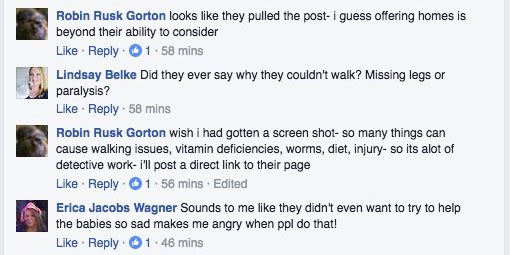
There are more comments just like those, but who cares, honestly? I would like to highlight this one lady though. The only one on the string of comments I could find who didn’t automatically assume I’m a Demetra-killing illiterate, inexperienced monster. Maybe the rest of the sheeple above could learn something from her. She asked questions. She wondered if she had all the information. What a concept!

Wherever you are, Lindsay. Thanks.
In the end, the blocked unhinged lady apologized, starting with “I really hate rude rescues!” Now I’m no poet, but in the future, I’d suggest you start an apology with “I am sorry.” My response was something like “Go fuck yourselves, all of you.” Her friends started harassing me, calling me a “butt-hurt snowflake” if I remember correctly. I told that guy to die in a fire. And she kept pushing her lying narrative that Demetra is somehow in imminent danger of being murdered by me, deciding that I am a sad person and she feels sorry for me.
So… that ended well.
Here’s what many people don’t know. I block an average of 3-5 people a day. The first thing I do when I wake up is almost always block someone. This is what one apparent human being sent me recently in a direct Instagram message, along with a note that said “for every duck you rescue, I kill two.”
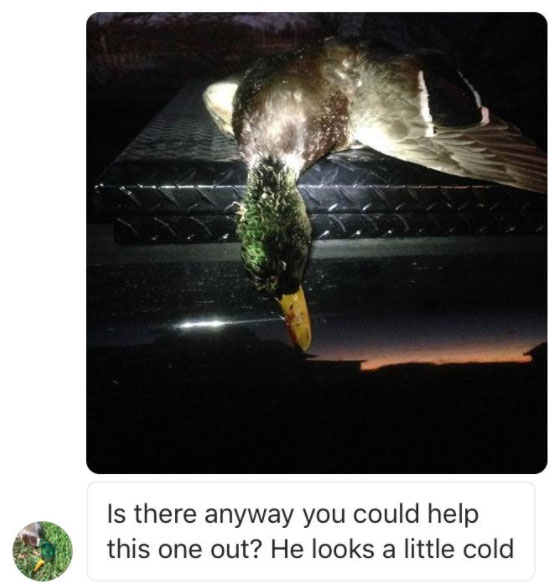
That was the first thing I saw when I woke up. Not every day is that bad, but after I was sent that note, I hated to check those Instagram direct messages from strangers.

When I have direct Instagram messages from strangers, I don’t get any notifications. So every once in awhile I check it, just to see what’s there, hoping it isn’t some redneck sending me pictures of dead ducks. This week I found two messages that were a couple of days old. Both were people with duck questions. One of them asked a question. Then asked again. Then said something like “Since you obviously don’t care about animals, I’ll go ask someone who does!” I never received a notification that she had sent a message, but she made sure to assume I was just ignoring her and that I’m an uncaring person. I responded nicely to her and noted that I don’t get notifications, but I never heard back.
This is what social media is like for me, all day long. People expect my immediate attention because I run a rescue. I OWE them my time. For free. All day long. Immediately. What on earth could be taking me so long to respond?! Is it like I’m RUNNING A RESCUE OR SOMETHING MAYBE!?
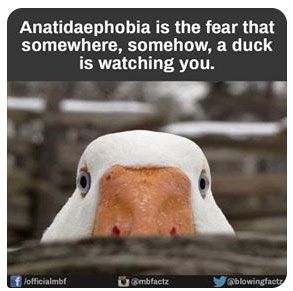
Meanwhile – and this isn’t meant to offend any one specific person, so please don’t take it personally – but meanwhile, I get sent the same memes and duck videos and chicken photos over and over and over again. And I have to look at each one because in the messages and direct messages and texts and notes between them, there might be someone with a bird who needs help. By the way, that photo above is a goose. Not a duck.

In case it isn’t obvious, I’m going to be severely limiting my social media time for the rescue. But before you get it twisted, don’t assume I am overwhelmed. I am quite happy. I get up each morning and sing to my rescued birdies. I often take Demetra through the drive-thru latte stand with me where she gets oats and I get a soy latte. I hold Danny girl and feed her, talk to whatever other goobers are in the house and head out to the aviary. I say “Good morning, you handsome boy!” to Miles, and give a hearty hello to everyone who cares, and even those who don’t. I open the winter pen and let Joey and crew out, and rush to get them their breakfast while they run around in anticipation. Teddy lunges into my arms as I position him in front of the food and water dish, while Little Quack paces about, waiting for his turn. I laugh at their goofy antics, we chat and I make sure they’re dry and warm and fed and watered and happy. And every few hours I do it all again, until I tuck them in at night.
They bring me a lot of joy. Sharing their joy and their stories with others used to be fun too. But it’s not anymore. The world is different. And honestly, my purpose is not to run an endless stream of duck and chicken photos that brighten up your day. My purpose is to improve the lives of these birds, and to get others to view them as individuals and stop exploiting them. So to that end, here are some ways you can help:
1. Stop eating animals and animal products.
2. Don’t support the use of animals for fashion, research or entertainment.
3. Don’t breed, buy or hatch animals. Rescue them.
4. Educate people that bread is bad for ducks.
5. Educate people that for every backyard hen, a rooster died.
The birdies will thank you for it.
We’ll still be around a little bit, to help any birds that may need it, as our space and time allow. But we are done sharing our rescues with the world. We thank you for the 13+ years of sharing in their lives, and hope that you’ll use the few minutes we’ve freed up in your day to pay it forward, for the birdies.
Love and quacks,
Tiff and the rescued flock

